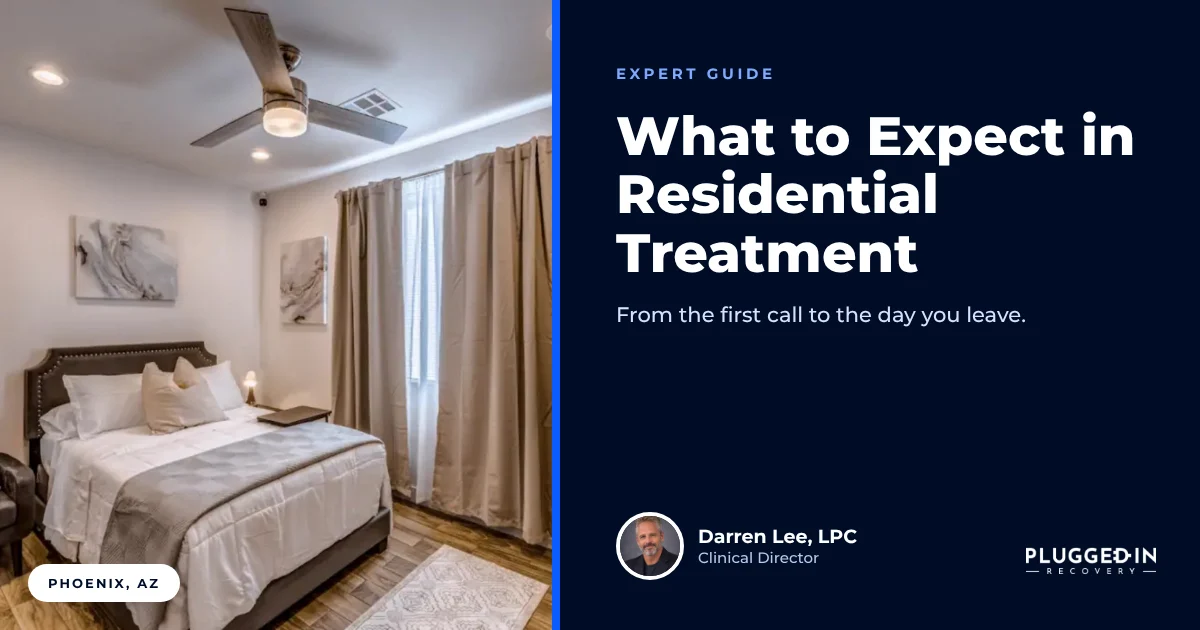
Here’s what to expect in residential treatment: you move in, usually for 30 to 90 days, and someone else worries about the schedule for a while. Mornings start with a check-in, therapy fills most of the day, and dinner is cooked for you. Before you leave, there’s a plan for what comes next.
This guide comes from Darren Lee, LPC, our Clinical Director. He’s EMDR-certified and oversees care at our homes in Phoenix and Scottsdale, and a lot of what he shares here isn’t what most people picture.
Key takeaways
You can start with one phone call, and a family member can make it.
Your days have a shape, but you still get real downtime.
Nobody’s going to rush you into your worst memories.
Leaving gets planned early, sometimes by week two.
How Residential Treatment Works
You sleep where you get treated. That’s the short version of residential care, and it’s why people choose it when outpatient hasn’t work or home isn’t a safe place to start. Stays here run 30 to 90 days. How you’re doing decides the length, not a package you bought.
You’ll hear “inpatient” and “residential” used like they’re the same thing, and mostly they are. Inpatient can mean a hospital, though. Ours looks like a home. That’s the idea behind our luxury residential rehab in Phoenix, which runs out of private houses in Phoenix and Scottsdale.
How long is long enough? The National Institute on Drug Abuse has an answer for that, and it’s longer than most people hope. Don’t panic about that number. Step-down care after the residence counts too.
3 months
the minimum most people need in treatment to reduce or stop use
It starts with one phone call, and it doesn’t have to be you who makes it. A spouse or parent can call for you. From there we check your insurance, do a pre-assessment and pick a date. If you qualify, you could even come in the same day.
Step
What happens
First call
You, or someone who loves you, tells admissions what’s been going on.
Insurance check
We look at your benefits so the cost isn’t a surprise. Most major plans work here. AHCCCS and Medicaid don’t.
Pre-assessment
A clinician goes over your health, your use and your mental health.
Intake
You get a start date. Sometimes that’s today.
Use the days before you arrive to handle work and home. If you’re eligible, FMLA leave can cover inpatient care at a treatment center. And yes, there’s a packing list for rehab, mostly so you don’t show up with mouthwash that has alcohol in it.
Your First Day in Residential Treatment
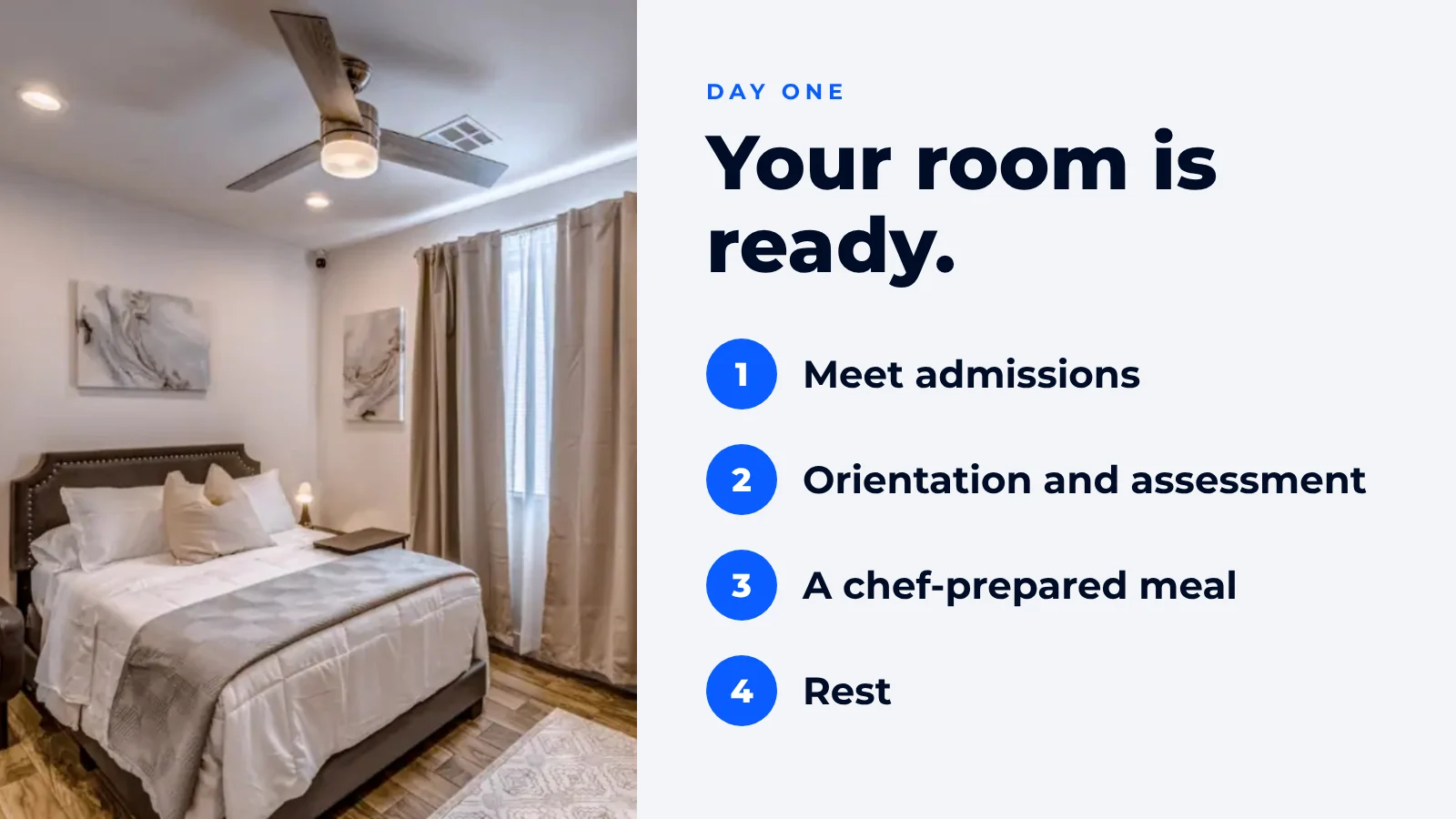
Honestly, the first day is mostly paperwork and getting your bearings. Admissions answers your last-minute questions, you get an orientation, and a clinician sits down with you for an assessment. Your room’s ready, and there’s food. Nobody’s going to ask for your life story before dinner.
Need detox? Then that gets sorted out first. Stopping alcohol or benzodiazepines on your own can be medically serious, so therapy waits until you’re steady enough to get something out of it.
You’ll probably feel nervous on day one. Maybe tired, maybe sure you’ve made a mistake. Plenty of people do. Find your room, meet a few people, sleep.
A Typical Day in Residential Rehab
No two days are identical, but a typical day in residential rehab has a shape to it. You’ll eat breakfast, check in with the group, spend the day in sessions, and wrap up after dinner. There’s downtime on purpose. Nobody can do hard emotional work for twelve hours straight.
Morning: breakfast from the chef, then a check-in group and usually something like CBT (Cognitive Behavioral Therapy).
Midday: groups change day to day. Life skills one day, yoga the next. Lunch somewhere in there.
Afternoon: your one-on-one, maybe art therapy, and time to work out or do nothing.
Evening: dinner, a wrap-up or peer meeting, then a movie or a call home.
Mindfulness sneaks into a lot of this, and Darren has a reason. People in active addiction are “wildly unaccustomed to being present in the here and now,” he says. When your whole day goes to planning the next drink, sitting still feels strange.
So you practice. You notice your breathing. You learn to “observe their thoughts rather than attach to their thoughts,” as Darren puts it. He doesn’t oversell much, but he calls those strategies “gold.”
Why Early Treatment Focuses on Stability
This is the part that surprises people. You might expect rehab to go straight at the worst things that ever happened to you, and Darren’s team usually doesn’t. Your brain needs time to catch up with the decision to stop, so they teach grounding skills and coping tools first.
“I hesitate to do a ton of trauma work in early recovery.”
Darren Lee, LPC, Clinical Director
His reasoning is practical. “We’re not trying to unbox… significant early childhood traumas that will then need to be sewn up and tightened up prior to their discharge,” he says. Why rip something open that you won’t have time to close?
There’s biology here too. Darren points to scans of people new to recovery, and he figures it takes a year and a half to two years before things really shift.
“The brain is still acting in very much the same way it did during the addiction.”
Darren Lee, LPC, Clinical Director
None of this means we ignore trauma. It gets taken seriously, and EMDR is on the table if one memory won’t leave you alone. It’s a question of when.
How Self-Reflection Works in Residential Rehab
Nobody here is going to corner you and tell you you’re an addict. Darren says that doesn’t work anyway. Instead, soon after intake, you sit down with staff member Greg Bravo for a guided First Step. It comes from the 12 steps, though you don’t need to be religious.
It’s “a series of questions that are very specifically aimed at cultivating that awareness and that insight,” Darren says. The questions get personal fast. When did you last hold a job for a full year? What did your kids miss? What would you have done differently sober?
You answer them yourself. That’s the point. A label someone hands you rarely sticks, and the thing you say out loud on your own usually does. And if the 12 steps aren’t for you, we’ve got non-12-step programming as well.
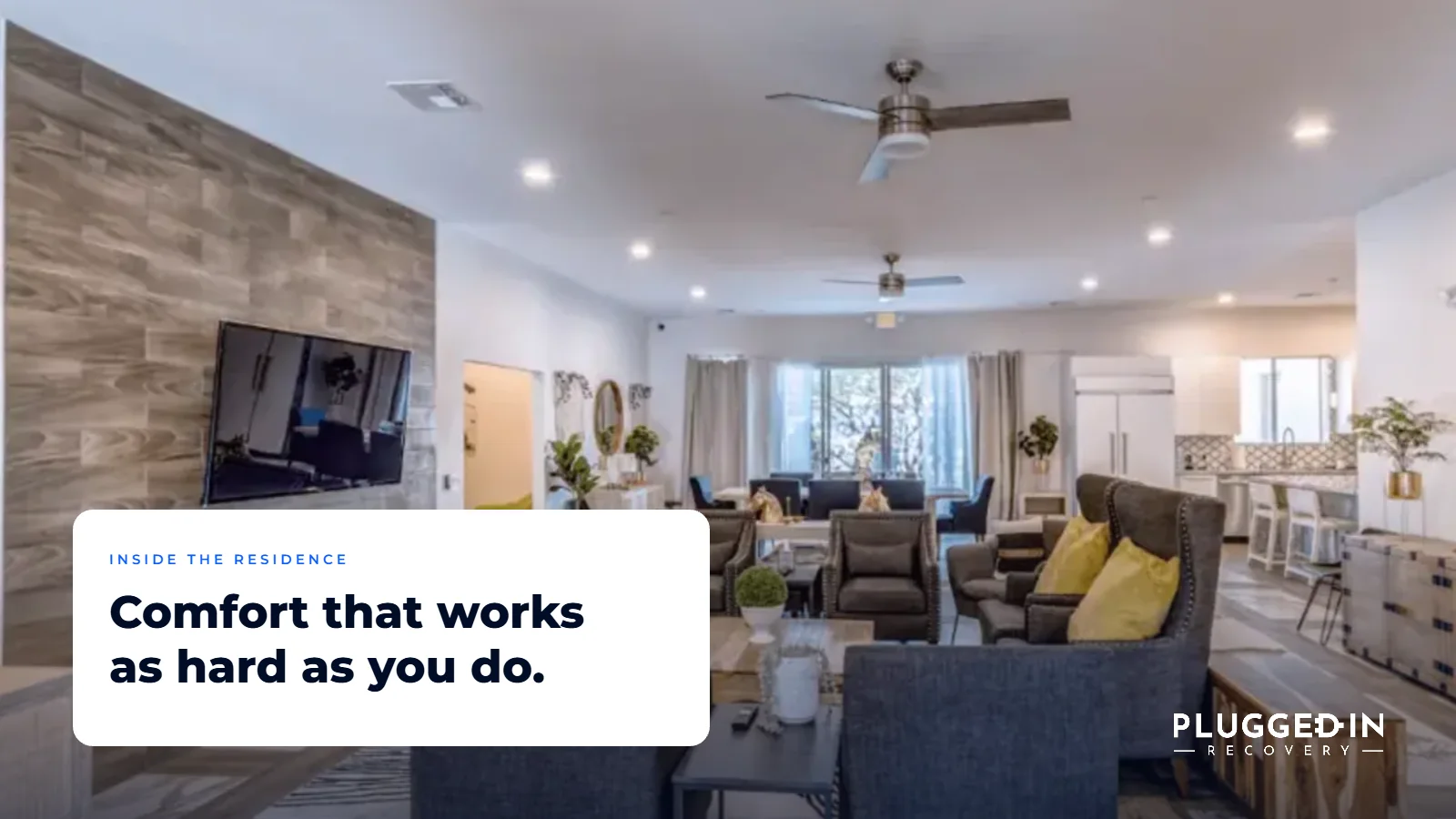
It looks more like somebody’s nice house than a facility, because that’s what it is. You keep your phone. A chef cooks. Your therapy week might include CBT, DBT, ACT, art and yoga, and you can ask for a referral to equine therapy.
The two homes aren’t identical, so here’s the quick version:
Feature
Phoenix residence
Scottsdale residence
Rooms
Every room is private, with its own bathroom
Private rooms available, Tempur-Pedic queen beds
Meals
Chef-prepared
Full-time chef
Wellness
Zen room, yoga, meditation
Pool, hot tub, big gym, yoga
Stay length
30 to 90 days
30 to 90 days
Yes, you really can keep your laptop and phone. If that starts getting in the way, the team can set limits. Our page on luxury rehab in Phoenix has photos of the Phoenix house if you want to see it first.
Equine therapy surprises people the most. Darren admits he’s no horse expert, but what he hears back is that “it can be a powerful experience,” mainly because it gets people out of their heads.
How Families Stay Involved
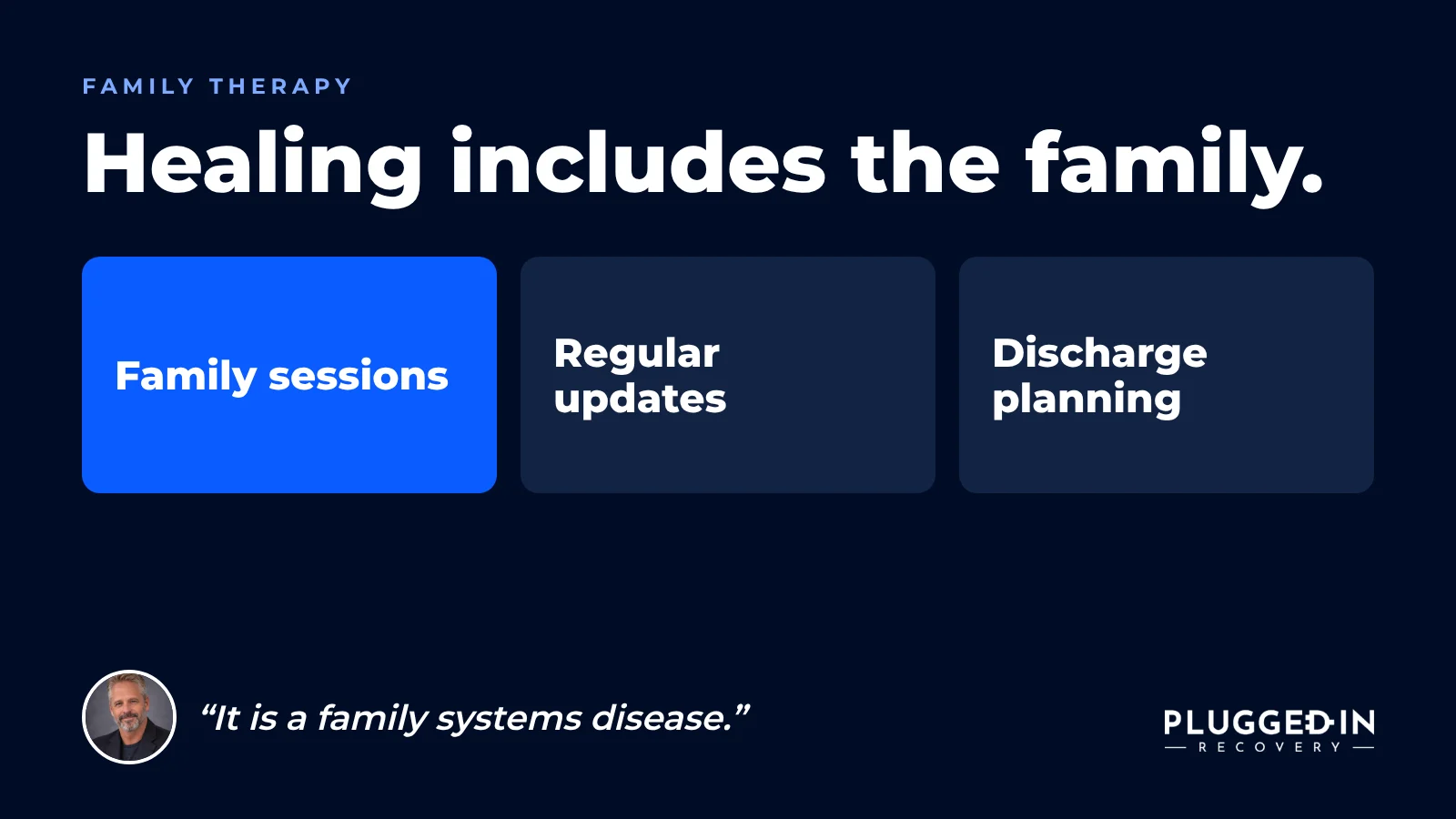
Your family doesn’t get dropped off at the curb and forgotten. They can be on the very first call, and from there we set up family therapy sessions, regular updates and help with how you all talk to each other. When it’s time for discharge planning, their role comes up too.
Darren defines addiction as a disease of family systems. It’s not about blaming anyone. What he means is that when your family receives support in its own right, the home you return to changes.
Want to know about visits or calls home? Ask admissions before you come, since it depends on the house and on where you are in treatment.
What Happens When Residential Treatment Ends
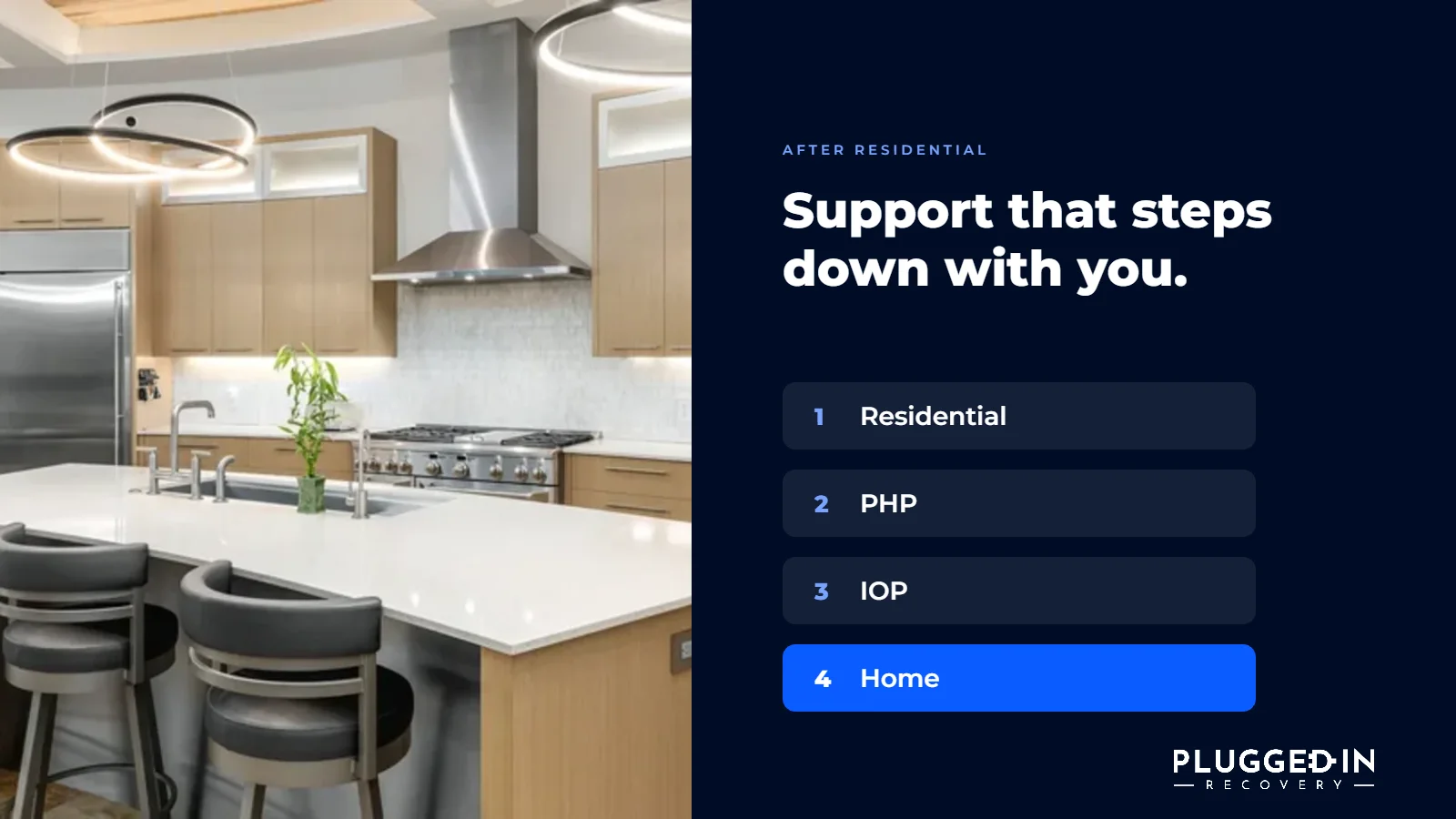
You won’t walk out the door with a handshake and good luck. Most people step down to outpatient care in Chandler, luxury sober living, or both, and therapy keeps going through aftercare. Your team usually has a rough idea of that plan by your second week.
Darren’s advice for after discharge isn’t complicated: “stay connected to a therapist once a week, once every other week.” Add some kind of community on top, whether that’s a 12-step meeting or a church group.
If you’re trying to figure out how long you’d be gone, our guide on how long alcohol rehab takes breaks it down.
And some people get more than they came for. Once things settle, Darren says, “a new world can open up for people.” He’s thinking of the ones who never saw what a calm house looked like growing up.
Residential Treatment in Phoenix at Plugged In Recovery
Knowing what to expect in residential treatment makes the first call a little less scary. We run private homes in Phoenix and Scottsdale, outpatient care in Chandler and luxury sober living for the step down, so you can stay with one team as your needs change.
If drinking is the main problem, our luxury alcohol rehab in Phoenix works the same way, and we can treat the anxiety, depression or trauma that often comes with it.
Still comparing places for luxury alcohol rehab in Phoenix? Ask us anything. We’re Joint Commission-accredited, and if you’re shopping for luxury rehab in Phoenix, that’s a fair thing to check everywhere you call.
You live on site and go to individual therapy, groups and skills work, with meals and sleep on a steady schedule. Medical or psychiatric help comes in when you need it. Here, that can mean CBT, DBT, medication management and dual diagnosis care, plus a plan for afterward.
How long does someone stay in a residential treatment facility?
Here, it’s 30 to 90 days. A month is plenty for some people. Others need longer, especially if depression, anxiety or trauma is part of it. Your team looks at how you’re actually doing before anyone picks a date, so nothing’s locked in on day one.
What to bring to residential treatment?
Bring your photo ID, insurance card, a prescription list and your meds in their original bottles. Pack about a week of comfortable clothes in layers. Skip anything with alcohol in it, plus valuables and over-the-counter medications. Staff has those. You can’t bring a car either.
What does it mean to be sent to a residential facility?
Usually, someone decided outpatient help isn’t enough right now. That someone might be a doctor, a judge, your family or your job. It isn’t punishment, even if it feels that way at first. You’re going somewhere with structure so you can get steady.
Luxury rehab is residential addiction treatment in a private, comfortable home. You have your own room, you can usually keep your phone, and the treatment plan is built around you instead of a group.
The comfort is nice, and it does help people stick around. It isn’t what gets them better. That comes from getting stable, the right therapy and an early plan for life back home.
Below, we walk through what our own residences in Phoenix and Scottsdale include, and we asked Darren Lee, LPC, our Clinical Director, what matters underneath all that comfort.
Key takeaways
Comfort is the setting, not the treatment.
At Plugged In: private rooms, a chef and your own phone.
The first weeks are for getting steady, not deep trauma work.
Discharge planning starts early to lower relapse risk.
What Luxury Rehab Actually Means
Most definitions stop at the amenities. That’s understandable, since the amenities are the easiest part to photograph. But a nice room with a weak clinical program is just a nice room.
Two of them describe what a good luxury program should deliver: treatment that “attends to multiple needs of the individual, not just his or her drug abuse,” and the reminder that “remaining in treatment for an adequate period of time is critical.”
Comfort helps with the second one. People are more likely to stay when they aren’t miserable.
Luxury Rehab Amenities at Plugged In Recovery
Here’s what that comfort looks like day to day at our two residential homes.
Private Rooms and Ensuite Bathrooms
Every room at our Phoenix residence is private, with its own ensuite bathroom, a full-size bed and a TV. Our 5,725-square-foot Scottsdale home has private rooms with Tempur-Pedic queen beds and streaming on every flat-screen.
Having your own space means real sleep, and a door you can close after a hard group.
Chef-Prepared Meals
A full-time chef runs the kitchen in Scottsdale, and meals in Phoenix are chef-prepared too. Nutritional counseling is part of the program, which matters when your body has been running on alcohol or drugs instead of food.
Pool, Gym and Wellness
The Scottsdale residence has a full-size diving pool and hot tub, a full gym, a putting green, a firepit and an in-house movie theater. Phoenix has a zen room for quiet reflection. Both homes offer:
Yoga and meditation
Holistic wellness and spa services
Art therapy
At a resident’s request, we can also arrange massage, acupuncture, red light sauna, cold plunge, IV therapy and equine therapy by referral.
Phones and Laptops Stay With You
This is the one that surprises people. Most residential programs take your phone at the door. We don’t, and Darren doesn’t think taking it would make treatment work any better.
At the end of the day, I’m not sure there’s any real evidence that not allowing somebody to have their phone promotes a better treatment experience or a more effective treatment experience than a place that does allow people to have their phones.
Darren Lee, LPC, Clinical Director
He’s also realistic about the reason other programs lock phones away.
The idea is if people are going to have conversations with their drug dealers, or if they’re going to do some sort of gambling online, or participate in a nefarious way on their phone, then they’re going to do it.
Darren Lee, LPC, Clinical Director
For working professionals and parents, staying reachable is often what makes saying yes to treatment possible in the first place.
What a Day in Luxury Rehab Looks Like
The schedule under all of this isn’t so different from what happens in alcohol rehab at any good program. A typical weekday at our Scottsdale residence runs roughly like this:
Morning: a chef-prepared breakfast, then a check-in or process group to set goals for the day
Midday: CBT skill-building, psychoeducation and individual counseling
Afternoon: life skills, relapse prevention and experiential activities
Evening: a nightly wrap-up, peer-led meetings and, some nights, a movie in the theater
Therapy draws on CBT, DBT, ACT and trauma-informed care, and you can choose a 12-step or non-12-step path.
Stabilization Comes Before Deep Trauma Work
A common assumption is that residential treatment means opening up every painful memory right away. Darren sees the first weeks differently.
I do believe that our time is best spent stabilizing people, getting them grounded on their feet, and helping them identify, develop, and pursue a strong aftercare plan.
Darren Lee, LPC, Clinical Director
So the early work centers on getting physically and emotionally steady, building coping skills and treating anxiety or depression. Trauma isn’t ignored. Our therapists address it, and Darren is EMDR-certified. The heavier reprocessing usually comes later, once someone is stable.
Do Luxury Rehabs Work?
Short answer: the good ones do, and it has nothing to do with the thread count. A well-known JAMA review compared addiction with other long-term illnesses and found relapse rates were about the same as for high blood pressure or asthma.
Nobody calls blood pressure treatment a failure when the numbers creep back up. You adjust and keep going.
Where someone goes after treatment matters just as much.
If we take a newly recovering person and place them right back into their old environment, the likelihood of relapse is… overwhelmingly high.
Darren Lee, LPC, Clinical Director
That’s why we run luxury sober living for the step after residential care. It gives people a structured, sober home instead of sending them straight back to the old one. So when you’re asking whether a luxury rehab works, look at what it does on the way out.
If you’re still deciding about treatment at all, we wrote a separate piece on whether rehab is worth it.
Aftercare Planning Starts on Day One
At Plugged In, the conversation about life after treatment begins almost immediately.
When somebody enters treatment… the immediate focus needs to be on setting them up for success when they discharge.
Darren Lee, LPC, Clinical Director
By the second week, the clinical team is usually sketching what aftercare will need to look like. For most people that includes:
Ongoing therapy, weekly or every other week at first
Sober living when home isn’t a safe place to start
Community support, from 12-step meetings to other recovery groups
Who Luxury Rehab Is Right For
Luxury rehab isn’t the right fit for everyone, and a good admissions team will say so. For people weighing a luxury alcohol rehab in Phoenix, it tends to make the most sense for those who:
Have work or family responsibilities and want to stay reachable by phone
Are dealing with anxiety, depression or trauma alongside drinking or drug use
Have tried outpatient treatment and need more structure
Value being treated as an adult making their own decisions
Not sure which level of care fits you? Call our admissions team at 602-527-8096 and talk it through.
Luxury Rehab in Phoenix at Plugged In Recovery
Plugged In Recovery offers residential treatment at our Phoenix and Scottsdale residences, outpatient care in Chandler, and luxury sober living for the step after. Stays run 30 to 90 days based on progress, and same-day admission is available.
From our conversation with Darren Lee, Clinical Director at Plugged In Recovery.
Has anyone misused their phone at Plugged In?
Well, at Plugged In, no. It hasn’t. But it has absolutely happened at other facilities where I’ve worked that don’t allow phones. So that’s the irony of it.
Darren Lee, LPC, Clinical Director
What happens if someone misuses their phone?
If we discover it, we will put restrictions on it. So it’s not no holds barred phone usage.
Darren Lee, LPC, Clinical Director
Frequently Asked Questions
What is luxury rehab like?
Luxury rehab feels closer to a private residence than a hospital. You’ll have your own room, chef-prepared meals and a schedule that mixes individual therapy, clinical groups and wellness time, often with your phone and laptop still allowed. It’s built for rest.
What are the three types of rehab?
The three main levels are residential (inpatient), where you live on site, partial hospitalization, with full days of treatment while living at home, and intensive outpatient, a few hours a day several days a week. Luxury rehab is usually residential.
Is luxury rehab worth it?
Sometimes. It’s worth it when the treatment is as good as the house. Before you sign anything, ask who the therapists are, what methods they use, and what happens after you leave. If all you hear about is the pool and the chef, look somewhere else.
Does insurance cover luxury rehab?
Often, yes, at least partly. Marketplace plans have to cover substance use disorder treatment, and plenty of private plans pay toward residential care. What you get depends on your plan and on medical need. A free insurance check before admission will tell you.
There’s no perfect script, but there is a wrong way to do this, and it’s the way most people try first: confrontation, an ultimatum, or bringing it up mid-argument.
None of that tends to work. What helps is timing, specific language, and, in some cases, a structured approach backed by real research.
Timing Matters More Than the Words You Choose
The single most common mistake is bringing this up at the worst possible moment, mid-fight, at a family gathering, or while the person has been drinking.
When Not to Have This Conversation
While the person is intoxicated
During or right after an argument about something else
In front of a group, even well-meaning family
When you’re too angry to stay calm through their reaction
The NIAAA’s own guidance is direct on this: think through what you want to say beforehand, and consider practicing it with someone else first. Wait until the person is sober, stable, and actually capable of hearing you, not defending themselves.
What to Actually Say
Vague concern is easy to brush off. Specific observation is harder to argue with.
Describe What You’ve Seen, Not What You’ve Heard
Stick to what you personally observed, not what someone else told you or a general pattern you’ve assumed. “I noticed you seemed unsteady last night” lands differently than “everyone says you’ve been drinking too much.”
Use “I” Statements Instead of Accusations
“I’m concerned about your drinking” opens a conversation. “You have a drinking problem” tends to close one immediately. You don’t need to settle on the right label, addiction, alcohol use disorder, heavy drinking, before you can talk about specific behaviors and how they’ve affected you.
Bring Facts, Not Just Feelings
Some people respond better to information than emotion. Having a basic understanding of what alcohol use disorder actually looks like clinically can help the conversation feel less like an accusation and more like genuine concern grounded in something real.
The Approach With an Actual Track Record
If a direct conversation hasn’t worked, or you’re worried it won’t, there’s a specific method worth knowing about: CRAFT, Community Reinforcement and Family Training.
Why CRAFT Works Where Confrontation Doesn’t
CRAFT was built specifically for situations where a loved one hasn’t asked for help and may actively resist it. Rather than one confrontation, it works through everyday interactions: reinforcing sober moments together, stepping back from shielding the person from natural consequences, and approaching with curiosity instead of ultimatums.
Across clinical trials, CRAFT has engaged roughly two-thirds of treatment-refusing drinkers into actual care, substantially outperforming traditional confrontation-based approaches. That’s not a small margin; it’s the difference between a method that occasionally works and one built around real behavioral research.
What to Do If Withdrawal Is Already a Concern
If the person you’re worried about already shows signs of physical dependence, this conversation carries an added layer of urgency and caution.
Signs the Situation May Already Be Medical, Not Just Behavioral
Shakiness, sweating, nausea, or anxiety when they haven’t had a drink recently
A history of trying to quit and experiencing physical symptoms
Drinking that happens daily or almost daily over an extended period
The NIAAA estimates alcohol withdrawal accounts for roughly 260,000 emergency department visits and 850 deaths annually in the U.S. If these signs are present, don’t encourage a sudden, unsupervised stop. Our article on is it safe to detox from alcohol at home covers exactly why medical involvement matters at this stage.
After the Conversation
One conversation is rarely the whole story, and that’s normal, not a failure.
What Usually Comes Next
It may take several conversations before the person is ready to act
If they return to drinking after any period of change, responding with anger tends to deepen the cycle rather than help
Having specific next steps ready, a provider’s number, a program, matters more once someone says yes, since the window doesn’t always stay open
If the pattern you’re describing sounds like it’s moved past “too much” into something more serious, our article on signs you need alcohol rehab can help you figure out where things actually stand.
If You’re Ready to Take the Next Step Together
At our Scottsdale residence, we regularly talk with family members before the person they’re worried about ever calls, walking through exactly how to approach this conversation and what happens if they say yes.
If you’re not sure how to start, or you’ve tried and it didn’t go anywhere, a call can help. Call us (480) 841-9915
Frequently Asked Questions
What’s the best way to start the conversation about someone’s drinking?
Choose a private, sober moment and describe specific behaviors you’ve personally observed, rather than repeating what others have said. Using “I” statements, like “I’m concerned about your drinking,” tends to land better than accusatory language.
What if they get defensive or deny it?
This is common, and one conversation rarely resolves everything. Staying calm rather than escalating, and following up again later, tends to work better than pushing hard in a single sitting.
Is there a specific technique that actually works better than just talking?
CRAFT (Community Reinforcement and Family Training) is research-backed and engages roughly two-thirds of treatment-refusing individuals into care, more effectively than confrontation-based approaches. It works through consistent, everyday interactions rather than a single intervention.
Can bringing this up cause a dangerous reaction?
The conversation itself typically isn’t dangerous, but if the person has significant physical dependence, encouraging them to quit abruptly can be. If you notice withdrawal symptoms like shaking or sweating when they haven’t had a drink, medical guidance should be part of the plan.
How do I take care of myself while dealing with this?
Support groups like Al-Anon exist specifically for people in this situation. Talking to a therapist, setting boundaries, and not carrying this entirely alone all matter, this affects you too, not just the person drinking.
When a loved one is struggling with alcohol dependency, the entire family unit suffers. Families often carry immense trauma from past relapses, broken promises, and the sheer exhaustion of trying to manage someone else’s behavior. A common question we hear is how to help an alcoholic family member without enabling them or pushing them further away.
For years, pop culture has taught families that they need to stage dramatic confrontations or wait for their loved one to hit “rock bottom.” Clinical research paints a very different picture.
Laura Zsako, our Primary Residential Therapist at Plugged In Recovery, explains what effective family support actually looks like within our clinical model. By looking at evidence-based practices and moving past outdated advice, we provide families with practical steps they can take today.
Why Traditional Confrontations Often Backfire
Many families feel pressured to stage a surprise intervention, often relying heavily on confrontation, ultimatums, and shame. When an individual with a substance use disorder is backed into a corner and confronted by an angry group of relatives, their natural psychological response is extreme defensiveness.
Laura emphasizes how damaging negative confrontation can be for someone who is already struggling. “They have family and friends that are like, ‘You, excuse my language, you messed up. I am disappointed in you.’ That is the worst thing that you can hear is I am disappointed in you.”
Instead of motivating change, this often results in the individual isolating themselves further, making treatment even less likely and is not how to help an alcoholic family member.
If you are unsure of the best way to support your family member, our clinical admissions team is here to guide you through a free and confidential conversation at (602) 527-8096.
The Research Behind What Actually Works
The clinical standard for family involvement is the Community Reinforcement and Family Training (CRAFT) model. This approach is positive and motivational, helping friends and family work smarter to support someone suffering from substance use problems.
Instead of confrontation, CRAFT builds on principles of positive reinforcement. Families learn how to help an alcoholic family member by rewarding sober activities and discouraging activities that include drugs or alcohol. The model also teaches families to allow natural consequences, such as not calling in sick for a loved one the day after they stay up drinking.
Research has shown that seven out of ten family members who participate in the CRAFT program are successful in engaging their loved one into a treatment program. Furthermore, CRAFT participants report lower levels of anger, anxiety, and depression, independent of whether or not their loved one gets help.
Navigating Boundaries and Relapse
Relapse is terrifying for families, but how you respond sets the tone for the next steps in recovery. It requires balancing deep support with firm clinical boundaries.
Laura shares a recent experience with a family navigating this exact crisis. “His mom reached out to me and said, ‘Hey, my son relapsed. We built a connection with you… you were the only person that I knew to call that wouldn’t make me feel like crap.’ I wanted to make sure that I supported her as well as a mom, too, right? And I stepped back and I said, ‘I know this is your pride and joy,’ right? But I think it is having those hard conversations too of putting in boundaries, having healthy communication, and getting them back into treatment.”
Part of establishing those boundaries is accepting the reality of personal readiness. Families cannot force recovery.
“I told the mom who reached out to me, she said, ‘Oh, well, can’t you just come pick him up?’ And I said, ‘Um, I am hearing you, no.’ No, I can’t do that,” Laura explains. “But he has to want it. If he doesn’t want it, then maybe this isn’t the right time. I can want it till I am blue in the face, right, but at the same point too, he has to want it.”
To help your loved one access the care they need without added financial stress, you can securely verify their policy benefits with us discretely and confidentially.
Integrating Family into the Plugged In Model
At Plugged In Recovery, we do not view family therapy as an optional feature. It is a core component of how we build lasting stability. Our luxury alcohol rehab in Phoenix allows for a highly personalized, community-focused approach.
“I think having 10 beds is awesome because we get the opportunity, everybody knows everybody,” Laura says. “It is a very family-oriented small town kind of mantra.”
Families sometimes misunderstand the rigorous nature of our luxury center, assuming their loved one is simply relaxing. Laura is quick to correct this misconception. “I will get family members go, ‘Oh, well man, they are at a resort, why haven’t I heard from my loved one?’ And I was like, ‘Well let me tell you they are not just tanning.’ We keep the clients busy from 7:30 in the morning till 8:30 at night.”
We educate loved ones on the exact tools the patient is learning, ensuring that when the patient eventually steps down into our outpatient alcohol rehab in Phoenix, they are returning to a home environment that speaks the same clinical language.
Comparing Family Support Strategies
Support Model
Primary Strategy
Clinical Effectiveness
Traditional Intervention
Surprise confrontation and ultimatums
Often leads to defensiveness and treatment refusal
Complete Detachment
Disengaging until the individual seeks help
Leaves the family waiting passively for a breaking point
CRAFT Model
Positive reinforcement and strategic communication
Highly effective at engaging resistant individuals into treatment
Rebuilding Your Family Foundation Together
Watching a loved one battle an alcohol use disorder is an exhausting, traumatic experience for the entire family. You do not have to navigate this complicated clinical journey alone. Our dedicated team provides evidence-based family support alongside our exceptional patient care in a luxury alcohol rehab in Phoenix.
The constant cycle of anxiety takes a heavy toll on everyone involved. However, you absolutely do not have to navigate this complicated clinical journey by yourself. If you are ready to explore the next steps, we’re here to help you through this difficult time.
Laura Zsako Q&A
Why haven’t I heard from my loved one if they are at a luxury facility?
“A lot of times I will get family members go, ‘Oh, well man, they are at a resort, why haven’t I heard from my loved one?’ And I was like, ‘Well let me tell you they are not just tanning.’ I mean yes they have like an hour from 3:30 to 4:30 as like their free time, but I think what happens is within this beautiful facility we also are doing some really, really strong clinical groups.”
What should families understand about the daily schedule during residential treatment?
“I try to explain to family members and or friends or their employers with saying even though it looks pretty, we are here basically we keep the clients busy from 7:30 in the morning till 8:30 at night. They are in group therapy twice a week, they have recovery groups, they have in house meetings that we keep them pretty busy with, they have individual therapy.”
How does a small facility size actually benefit my family member?
“I think having 10 beds is awesome because we get the opportunity, everybody knows everybody. It is a very family oriented small town kind of mantra. It really gives them the opportunity to one open up a little bit more so because it is a smaller group. Two, to kind of help each other hold each other accountable clinically from a sobriety standpoint, mentally, physically.”
Why does my loved one insist they are fine when the family knows they need help?
“I validate them without assuming that they are fine because I sit across from clients all day every day and they are like, ‘Oh, I am fine.’ I am like, ‘Then why are you here? Let’s switch spots, you know.’ When they are high functioning they are trying to high overachieve, so what happens clinically, they mask anxiety. They mask depression. Most of them are like, ‘I want to be perfect,’ and I was like, ‘Help me help you with that.’”
What happens when the underlying issues start to surface during treatment?
“Usually around that fourteenth to fifteenth day, anxiety is coming out. Depressive mood is coming out. Sometimes they will isolate, sometimes they will cry out of nowhere, sometimes they will have a panic attack, sometimes their sleep is affected. I am constantly talking to the medical team, the doctor or psych, and saying, ‘Hey, this person is not getting any sleep, what can we do from a chemical imbalance standpoint to balance that out?’”
Frequently Asked Questions
Is family therapy covered by my insurance policy? Yes, family therapy sessions that are conducted as a component of the patient’s primary substance abuse treatment plan are generally covered by major commercial health insurance policies. Our admissions team handles the complete verification process to ensure your family understands the specific behavioral health benefits available to you before treatment begins.
How can I help an alcoholic family member who refuses to go to treatment? The most effective way to help a resistant family member is to change your own approach. Seeking guidance from a licensed therapist trained in the CRAFT model can teach you how to use positive reinforcement and improve communication. These evidence-based strategies are specifically designed to motivate treatment-resistant individuals.
When are families allowed to visit the residential facility? To ensure the safety, privacy, and clinical focus of all patients, visitation is highly structured. We typically ask families to wait until the patient has completed their initial stabilization and medical detox phase before scheduling on-site visits. Your primary therapist will coordinate visitation times that align with the patient’s treatment milestones.
What happens if the home environment is not supportive of recovery? If a patient’s primary residence is unstable or heavily triggering, returning home immediately after residential care is not recommended. In these instances, our clinical team assists families in arranging for the patient to transition into a reputable sober living home while they participate in our intensive outpatient program.
Spouse Observation Checklist
Recognizing the Shift in Your Partner
Noticeable increase in alcohol tolerance over the last twelve months.
Intense defensiveness when the topic of drinking is casually mentioned.
Drinking occurs in isolation or after the rest of the household is asleep.
Consistent failure to remember conversations that occurred late in the evening.
Visible morning anxiety that only subsides as the workday progresses.
For executives, business owners, and high-level professionals, the decision to seek treatment for alcohol use is often delayed by a unique set of fears. You know that you need clinical help, but the prospect of stepping away from your responsibilities feels impossible.
Concerns about career continuity, strict confidentiality from colleagues, and maintaining your professional reputation often overshadow the urgent need for medical care.
Here at Plugged In Recovery, we have designed a specialized alcohol rehab for professionals to close this exact gap. In this article, Laura Zsako, Primary Residential Therapist, describes what the clinical experience looks like within our luxury alcohol rehab in Phoenix.
By pulling back the curtain on our 10-bed privacy model and clinical scheduling, we can show you exactly how our program accommodates active work obligations while delivering elite medical care.
The Burden of the High-Functioning Alcoholic
The term “high-functioning” is often used as a defense mechanism. Professionals are exceptionally skilled at compartmentalizing their lives, ensuring that their performance in the boardroom masks the severity of their addiction at home.
This ability to overachieve is exactly what makes treating executives so complex. The surface looks pristine, but the internal foundation is often crumbling under the weight of immense stress.
Laura notes that breaking through this professional facade is the first critical step in treatment. “When they are high functioning they are trying to high overachieve, right, so what happens clinically, they mask anxiety. They mask depression. Most of them are like, ‘I want to be perfect,’ and I was like, ‘Help me help you with that.’”
Clinicians must approach this demographic with a specific balance of respect for their achievements and objective clinical boundaries. “I validate them without assuming that they are fine, right, because I sit across from clients all day every day and they are like, ‘Oh, I’m fine.’ I’m like, ‘Then why are you here?’ Let’s switch spots, you know.”
Treating the professional requires stripping away the executive title in the therapy room to address the severe, hidden symptoms of early sobriety. Often, once the alcohol is removed, profound anxiety and depressive moods surface rapidly. Recognizing and treating these dual diagnoses is central to our luxury alcohol rehab in Phoenix
Privacy by Design: The 10-Bed Capacity Model
For a professional, confidentiality is not a luxury. It is a strict requirement. The fear of ending up in a large, crowded facility where privacy is compromised keeps many executives out of treatment entirely.
To solve this, our residential program is intentionally capped at a 10-bed capacity. This intimate scale is the cornerstone of our privacy model. It eliminates the chaotic environment of standard rehabs and ensures that your identity and personal struggles remain completely confidential.
“Privacy and safety are huge,” Laura explains. “The majority of the clients that come to me that I work with in individual therapy, they say, ‘Laura, I feel safe here because it is low numbered.’”
This small census also fundamentally changes the therapeutic environment. “I think having 10 beds is awesome because we get the opportunity, everybody knows everybody. It is a very family-oriented small town kind of mantra. It really gives them the opportunity to one open up a little bit more so, right, cause it is a smaller group. Two, to kind of help each other hold each other accountable.”
For professionals seeking a highly discreet environment, you can explore the specific amenities and layout of our facility by visiting our comprehensive overview of our luxury rehab in Scottsdale.
Ready to discuss a treatment plan that respects your career and your privacy? A confidential assessment with our admissions directors is just a brief conversation away at (602) 527-8096.
Balancing Career Continuity with Clinical Rigor
Because our facility offers upscale amenities, families and patients sometimes confuse our medical program with an executive vacation. While the environment is beautiful and comfortable, the daily schedule is highly structured, evidence-based, and clinically intensive.
“I will get family members go, ‘Oh, well man, they are at a resort, why haven’t I heard from my loved one?’ And I was like, ‘Well let me tell you they are not just tanning.’” Laura clarifies. “I mean yes they have like an hour from 3:30 to 4:30 as like their free time, but I think what happens is within this beautiful facility we also are doing some really, really strong clinical groups.”
We utilize the comfortable environment to reduce your baseline stress, allowing you to engage in deep therapeutic work without distraction.
“Even though it looks pretty, right, we are here basically we keep the clients busy from 7:30 in the morning till 8:30 at night,” Laura states. “They are in group therapy twice a week, they have recovery groups, they have in-house meetings that we keep them pretty busy with, they have individual therapy.”
Comparing Care Models
Understanding the difference between a clinical program and a wellness retreat is crucial when making your decision.
Feature
Executive Wellness Retreat
Clinical Luxury Rehab
Primary Focus
Stress reduction and relaxation
Medical stabilization and addiction treatment
Medical Supervision
Minimal to none
24/7 nursing and psychiatric support
Daily Schedule
Spa treatments, optional yoga, open schedule
Rigorous clinical therapy from 7:30 AM to 8:30 PM
Treatment of Co-occurring Disorders
Not equipped for complex mental health diagnoses
Dual-diagnosis capabilities for anxiety and depression
Outcome Goal
Temporary relief from executive burnout
Long-term sobriety and behavioral restructuring
Deciding to seek medical help for an alcohol addiction does not mean sacrificing the successful career you have carefully built over many years. Our specialized alcohol rehab for professionals offers the exact clinical rigor you need within a highly confidential environment that respects your professional life. Take the first step toward lasting stability today.
Laura Zsako Q&A
How do high-functioning professionals typically present when they first arrive at treatment?
“I validate them without assuming that they are fine because I sit across from clients all day every day and they are like, ‘Oh, I’m fine.’ I am like, ‘Then why are you here? Let’s switch spots, you know.’ When you have somebody who is high functioning, they tend to overanalyze a lot of things. That overanalyzation can cause them to feel like they are a burden at times. They are trying to high overachieve. So what happens clinically is they mask anxiety. They mask depression. Most of them are like, ‘I want to be perfect,’ and I say, ‘Help me help you with that.’”
Why is a smaller facility size so important for someone concerned about their professional reputation?
“Privacy and safety are huge. The majority of the clients that come to me that I work with in individual therapy, they say, ‘Laura, I feel safe here because it is low numbered.’ It is ten beds. I think having that smaller niche for our facility really gives them the opportunity to open up a little bit more so because it is a smaller group. It also allows them to help each other and hold each other accountable clinically from a sobriety standpoint, mentally, and physically. It gives them a more personalized, client centered experience.”
What hidden symptoms typically surface once an executive stops drinking?
“Clients will come in and they are like, ‘I am only here for alcohol.’ And I am like, ‘Little do you know, fourteen days will hit.’ Usually around that fourteenth to fifteenth day, anxiety is coming out. Depressive mood is coming out. Sometimes they will isolate, sometimes they will cry out of nowhere, sometimes they will have a panic attack, sometimes their sleep is affected. Sometimes they will be in group and someone says a word and that triggers them. All of these dual diagnoses are super fun for me because I sit back and I am like, ‘You told me you didn’t have anxiety!’”
Is a luxury residential program just an expensive wellness retreat for executives?
“I get that all day every day from family members. They say, ‘Man, I should come to your facility, it is a resort, you have a pool and you can tan and you have red light and you have a cold plunge and I can actually get back into my workout routine.’ And I am like, even though it looks pretty, it is like looking in a snow globe. We basically keep the clients busy from 7:30 in the morning until 8:30 at night. They are in group therapy twice a week, they have recovery groups, they have in house meetings, they have individual therapy, and they have evening review.”
How do you handle a professional who refuses to accept that they have an underlying mental health issue?
“I am all about starting points. Say they come in and they are like, ‘Hey Laura, I have anxiety.’ I am like, ‘Okay, what is the definition of anxiety to you?’ Because your definition of anxiety is different than mine. Sometimes we have anxiety and we have no idea where it is coming from. That is totally an okay answer too. It is clinically looking at all of this and trying to have a starting point of dissecting everything. I constantly talk to the medical team, the doctor or psych, and say, ‘Hey, this person is not getting any sleep, what can we do from a chemical imbalance standpoint to balance that out?
Frequently Asked Questions
How does the facility ensure confidentiality from my employer and colleagues?
Our entire admissions and clinical process is bound by strict HIPAA regulations and federal confidentiality laws specifically governing substance abuse treatment records (42 CFR Part 2). We cannot and will not confirm your attendance or release any medical records to employers, colleagues, or even family members without your explicit, written consent. Our 10-bed model further ensures that your daily experience is discreet and highly private.
Can I keep my phone and laptop while in residential treatment?
We understand that completely severing contact with your business is not feasible for many executives. While we strongly limit device usage during clinical hours to ensure you remain focused on your therapeutic groups, we accommodate professionals by providing structured, protected time to check emails, use laptops, and make necessary business calls in a private setting.
Does insurance cover a luxury alcohol rehab program?
Yes, most major commercial health insurance policies, including high-tier executive PPO plans, cover residential addiction treatment as part of their behavioral health benefits. The exact out-of-pocket costs and deductibles will depend on your specific policy. Our admissions team provides a completely confidential insurance verification process to give you absolute financial clarity before you arrive.
Will entering rehab damage my career or violate my employment contract?
Seeking medical care for a health condition is highly protected. The Family and Medical Leave Act (FMLA) and the Americans with Disabilities Act (ADA) offer specific legal protections for employees seeking treatment for substance use disorders. Taking a medical leave of absence for an alcohol use disorder is an investment in your long-term cognitive and professional performance. Continuing to struggle with untreated addiction poses a far greater risk to your career trajectory.
How long does an executive residential program typically last?
Treatment length is always dictated by clinical necessity rather than a fixed calendar. While many professionals begin with a standard 30-day program to achieve initial stabilization and detox, our clinical team continuously evaluates your progress. We will work with you to determine the ideal length of stay and help you plan a step-down strategy that safely integrates you back into your high-demand work environment.
Spouse Observation Checklist
Recognizing the Shift in Your Partner
Noticeable increase in alcohol tolerance over the last twelve months.
Intense defensiveness when the topic of drinking is casually mentioned.
Drinking occurs in isolation or after the rest of the household is asleep.
Consistent failure to remember conversations that occurred late in the evening.
Visible morning anxiety that only subsides as the workday progresses.
How to go to rehab and keep your job? Well, going to alcohol rehab while keeping your job follows a clear process, but it is not the process most professionals expect.
Logistics come first, boundaries are established gradually, and some of the clearest paths forward at first glance look like insurmountable hurdles. The assumption that you must choose between your professional livelihood and your health keeps thousands trapped in a cycle of substance dependence.
Laura Zsako, our Primary Residential Therapist at Plugged In, will walk us through what we see every day. We will cover how the schedule accommodates demanding work hours, what confidentiality actually looks like, and how to navigate legal protections seamlessly.
If you are a professional deciding whether seeking help will cost you your career, this is exactly what making it work looks like.
The Identity of the High-Functioning Professional
The professional who wants help but cannot risk their job represents a specific demographic group. These individuals are often executives, managers, lawyers, medical professionals, or leaders who view their career their identity.
For this profile, the number one barrier to entry is not a lack of motivation or a denial of the problem. Instead, it is the deeply held belief that entering a treatment program will act as a professional death sentence, destroying years of networking, promotions, and reputational equity.
When you are used to managing operations, leading teams, and maintaining control over your environment, admitting that a substance has become unmanageable feels like a weakness. High-functioning individuals become experts at masking their struggles, using professional success as proof that their drinking is not truly out of control.
However, functional alcoholism is an exhausting strategy that brings down performance over time. The transition into recovery requires changing the narrative from a career risk to a structured, strategic plan for long-term optimization.
We make understanding your coverage simple and stress-free. Feel free to check your policy benefits confidentially.
The Logistics: What Needs to Happen First
Navigating clinical treatment while remaining employed has a predictable sequence. Understanding this order is what keeps professionals from letting fear dictate their medical decisions and provides a transparent roadmap for what to expect.
Stage
What is Happening clinically
What the Professional Experiences
Assessment
Evaluating clinical needs and determining if an outpatient level of care provides enough medical safety and structural support.
Extreme relief that viable options exist outside of a mandatory 30 day residential facility lockdown.
Legal Strategy
Establishing structural protections under federal laws if modified schedules or temporary leaves are required.
Anxiety decreases significantly as job security is explicitly confirmed through objective legal frameworks.
Scheduling
Customizing the Chandler schedule to wrap around standard corporate working hours and professional commitments.
A busy but highly structured and manageable routine. Hard days are followed by productive, clear-headed ones.
Integration
The professional learns advanced coping mechanisms in the evening and applies them at the office the next morning.
Small wins that compound over time. Better executive focus at work and an improved emotional presence at home.
Notice what is absent from this timeline, you don’t have to resign or pause your career. Looking for help doesn’t require burning down the structure you’ve spent decades building.
The primary barrier is rarely the willingness to change. It is the terror that treatment will cost you everything. By breaking down the process into phases, the journey shifts from an existential crisis into an actionable strategy.
You Can Keep Your Job While Getting Help
Navigating the terminology of addiction treatment can be confusing for families. Two of the most common levels of care you’ll encounter are Residential treatment and outpatient alcohol rehab in Phoenix.
While both offer rigorous clinical support, their structure, frequency, and living arrangements differ significantly. Understanding this distinction is crucial for matching a patient to the right level of support.
An Intensive Outpatient Program is a significant step down in intensity from residential care. IOP in Phoenix usually involves meeting three to five days a week for about three hours per session, but you live at home or in a sober living environment.
It provides much more flexibility. Patients can often choose morning or evening tracks, allowing them to integrate their treatment into their existing daily schedules seamlessly.
Feature
Luxury Residential Rehab
Intensive Outpatient Program (IOP)
Living Arrangement
Live on-site 24/7 in a luxury Scottsdale facility
Live at home or in a sober living environment
Clinical Intensity
The highest level of immersive care
A flexible, step-down level of care
Duration / Frequency
30 to 90 day personalized programs
3 to 5 days a week for a few hours
Amenities
Private rooms, gourmet meals, pool, fitness center, massage
Clinical facility access during session hours
Ideal Candidate
Needs 24-hour support and a complete environmental reset
Balancing daily life with ongoing recovery
A standard treatment plan often utilizes both. A patient might start in our luxury residential program for intense stabilization and then step down into IOP in Phoenix as they build confidence and demonstrate consistent sobriety.
What Actually Happens During a Treatment Week
A common misconception for IOP phoenix is that an outpatient alcohol rehab in Phoenix is just unstructured group talking. People picture a circle of folding chairs where everyone complains about their cravings. In reality, a typical week is highly scheduled, evidence-based, and clinically rigorous. When you arrive at our facility, you’re engaging in structured therapeutic modalities.
Individual therapy is also a core component of the week. Patients meet one-on-one with their primary therapist to dive into personal issues that are too sensitive for a group setting.
They’ll process trauma, discuss co-occurring mental health conditions like depression or anxiety, and set specific behavioral goals for the upcoming week.
Choosing an intensive outpatient structure over traditional residential inpatient care offers distinct operational advantages for the working professional.
Rather than removing an individual from their day-to-day life and placing them in an artificial bubble, outpatient care allows the client to face real-world stressors in real time while receiving immediate clinical processing.
Immediate Field Testing: When you learn a stress-regulation technique during an evening session, you have the immediate opportunity to apply it during a high-stakes board meeting the following morning. This creates a rapid feedback loop that accelerates the internalization of coping mechanisms.
Preservation of Routine: Maintaining a work schedule provides a stabilizing framework. The routine of waking up, dressed for the office, and fulfilling professional obligations prevents the psychological drift that often occurs when an individual is completely disconnected from their daily responsibilities.
Financial and Operational Continuity: Outpatient care mitigates the financial strain of uncompensated time away from work, ensuring that businesses continue to run smoothly and professional responsibilities do not fall behind.
How We Support Working Professionals at Plugged In
Professionals arrive at our facility asking one fundamental question expressed in many different ways: how do I execute this process without destroying my livelihood?
What we can honestly communicate to our clients is that navigating clinical treatment alongside demanding employment follows a distinct, manageable pattern. We understand that pattern intimately, and our clinical tracks are built specifically around it.
If your family dynamics and career trajectory require a high degree of structural flexibility, you can explore the comprehensive framework of our outpatient treatment options to see exactly how the clinical pieces fit together with your schedule.
For individuals looking specifically for localized, elite care that honors their professional boundaries, our specialized outpatient alcohol rehab in phoenix is engineered to remove the single biggest barrier for the working professional. We ensure you can prioritize your long-term health while maintaining absolute continuity in your career.
Laura Zsako Q&A
What does early recovery look like for someone balancing a demanding job, and what are they usually not expecting?
“Early recovery is undoubtedly a balancing act, but professionals are usually surprised by how much immediate relief they experience once the secret is out in a safe environment. They expect the logistics to be an impossible nightmare, but the real surprise is how quickly their work performance improves when they are no longer expending all their cognitive energy trying to hide a substance use issue from their peers.”
How do you handle the scheduling conflicts that inevitably arise with working professionals?
“We rely heavily on our flexible Chandler schedule. We understand that a hard stop at 5:00 PM is completely unrealistic for corporate executives, attorneys, or managers. We work directly with the client to build a clinical schedule that wraps around their mandatory career obligations, prioritizing long-term stability over rigid, institutional rules.”
When a stressful event happens at work, what do you tell clients about how to respond without relapsing?
“This is the exact operational benefit of outpatient care. In a residential setting, you are completely shielded from your boss, your emails, or your deadlines. In our program, you experience that intense work stress on a Tuesday afternoon, and by Tuesday night you are sitting in group therapy processing it. We teach them to respond with structural curiosity about their triggers rather than instantly numbing them with a substance.”
When a client finishes the intensive phase of the program, what determines whether they stay well while working full time?
“The professionals who stay well view their step down in care as a transition, not a finish line. They consistently maintain their weekly therapy appointments and they continue to enforce firm boundaries at work. Recovery holds long-term when the professional stops viewing their job as an acceptable excuse to skip their continuing care protocols.”
Frequently Asked Questions
How do you go to rehab and keep your job?
You can successfully complete treatment by utilizing an outpatient program that offers flexible clinical blocks. By utilizing legal protections like the Family and Medical Leave Act and the Americans with Disabilities Act, you can secure the necessary time for clinical care. Proactive communication with human resources regarding a medical leave of absence or modified schedule is the exact method for how to go to rehab and keep your job.
Does FMLA cover outpatient alcohol rehab in phoenix?
Yes, the Family and Medical Leave Act is a federal protection that applies to eligible employees across the country. If you meet the employment requirements, FMLA can be used intermittently to cover the specific hours you need to attend an intensive outpatient program, protecting your position while you receive localized care.
Can my employer fire me for seeking treatment?
Under the ADA, an employer cannot fire you simply for seeking treatment for a substance use disorder. Taking proactive steps to enter rehab protects you. It is important to note, however, that this protection does not cover drinking on the job or corporate policy violations that occurred before you sought professional help.
Will my coworkers find out I am in treatment?
No. Your medical privacy is strictly protected by HIPAA regulations. While human resources may need to know you are taking medical leave to process specific HR paperwork, they are not legally permitted to disclose your specific medical condition, diagnosis, or treatment plans to your coworkers or direct managers.
How long does it take for a professional to complete outpatient alcohol rehab?
The duration varies depending on the severity of the substance use. Stabilization can be established within the first few weeks, while rebuilding daily routines takes months. Most professionals participate in intensive outpatient programming for roughly 10 to 16 weeks before stepping down to weekly counseling as their clinical progress solidifies.
Spouse Observation Checklist
Recognizing the Shift in Your Partner
Noticeable increase in alcohol tolerance over the last twelve months.
Intense defensiveness when the topic of drinking is casually mentioned.
Drinking occurs in isolation or after the rest of the household is asleep.
Consistent failure to remember conversations that occurred late in the evening.
Visible morning anxiety that only subsides as the workday progresses.
Effective alcohol relapse prevention is a highly structured clinical process, not a test of sheer willpower. Here at Plugged In Recovery, we view relapse prevention as an active daily practice that requires the right tools and the right environment.
Laura Zsako, our Primary Residential Therapist, explains what evidence-based relapse prevention actually looks like within our specific outpatient model. Because she actively evaluates when a patient is ready to transition out of residential care, she knows exactly what it takes to succeed and build a lasting foundation. We are looking at the reality of the clinical experience and moving past basic definitions to show you exactly how our patients maintain their sobriety.
Moving Beyond Willpower: The Clinical Approach
A common misconception is that preventing a relapse simply requires a person to try harder. In reality, untreated addiction profoundly alters the brain, making willpower an insufficient defense mechanism. Relapse prevention requires a complete restructuring of how a person handles stress, daily routines, and unexpected triggers.
“When we evaluate someone transitioning out of residential care, we look closely at their foundation,” Laura explains. “If they have a safe home, a reliable routine, and a desire to face real-world challenges with clinical support, they are the perfect fit for an intensive outpatient setting to practice these new skills.”.
By shifting the focus from willpower to structured routines, patients at a outpatient alcohol rehab in Phoenix can approach their ongoing recovery with confidence. They are no longer fighting invisible urges; they are executing a strategic clinical plan.
Identifying Vulnerabilities with the HALT Method
One of the foundational evidence-based tools we utilize in our program is the HALT method. HALT is an acronym that stands for Hungry, Angry, Lonely, and Tired. These four basic physical and emotional states are the most common vulnerabilities that lead to cravings and subsequent relapse.
Laura notes that training patients to routinely check in with their bodies using the HALT method is transformative. “When a patient feels a sudden urge to drink, we teach them to pause and run through the checklist. Have they eaten today? Are they harboring resentment? Have they isolated themselves from their support network? Are they exhausted? Addressing these immediate baseline needs often diffuses the craving entirely.”
Hungry: Poor nutrition drops blood sugar levels, leading to irritability and poor decision-making.
Lonely: Addiction thrives in isolation, making human connection a vital defense mechanism.
Tired: Sleep deprivation compromises emotional regulation and weakens impulse control.
Trigger Mapping in the Real World
Alongside the HALT method, our clinical team heavily emphasizes trigger mapping. While residential treatment removes a patient from their primary triggers, an outpatient environment requires them to face those triggers and head-on.
Trigger mapping is a collaborative therapeutic exercise where patients identify specific environments, relationships, times of day, and emotional states that have historically led to alcohol consumption. By visually mapping these vulnerabilities, patients can develop concrete action plans. If walking past a specific neighborhood bar is a known trigger, the map includes an alternate driving route. If interacting with a specific family member causes severe anxiety, the map includes boundaries and pre-planned exit strategies.
The Outpatient Program as a Crucial Step-Down
The transition from 24-hour supervision to total independence is often too jarring for someone newly sober. This is why utilizing the outpatient program as a structured step-down is so vital.
An Intensive Outpatient Program occupies a critical middle ground in addiction treatment and alcohol relapse prevention. It provides rigorous clinical care at a outpatient alcohol rehab in Phoenix while allowing patients to sleep in their own beds. This specific balance of accountability and real-world independence is exactly where relapse prevention strategies are tested and solidified.
When evaluating care options, it is helpful to understand the practical differences in how relapse is prevented across different levels of support.
Comparing Treatment Contexts
Feature
Residential Care
Outpatient Care (Step-Down)
Living Arrangement
Live on-site 24/7 in a secure facility
Live at home or in a sober living environment
Trigger Management
Complete removal from real-world triggers
Actively navigating real-world triggers with clinical guidance
Relapse Prevention Focus
Initial stabilization and psychological education
Practical application of trigger mapping and the HALT method
Clinical Support
24-hour continuous supervision
Scheduled sessions three to five days a week
A standard treatment plan often utilizes both levels of care for alcohol relapse prevention. A patient might start in our residential program for intense stabilization and then step down into an outpatient alcohol rehab in Phoenix as they build confidence and demonstrate consistent sobriety. They are building sober habits in the exact environment where they will need to maintain them for the rest of their lives.
Ready to discuss your treatment options? A confidential and free assessment with our clinicians is just a brief conversation away (602) 527-8096.
Integrating Family and Aftercare Involvement
Recovery is not an isolated event that ends when a formal program concludes. Long-term success relies heavily on sustained aftercare involvement.
Once the intensive phase of the outpatient program is complete, our focus shifts to maintaining the structure the patient has built. This involves transitioning patients into ongoing weekly therapy sessions, psychiatric medication management if needed, and active participation in alumni support groups.
Furthermore, alcohol relapse prevention must involve the patient’s support system. We educate families on the HALT method and the patient’s specific trigger maps so that loved ones can recognize the warning signs of a potential relapse before it occurs. This collaborative approach ensures the home environment remains a safe and structured haven.
We make understanding your coverage simple and stress-free. Check your policy benefits securely and take your first step towards recovery.
Laura Zsako Q&A
How do we shift a family’s mindset from fearing a relapse to actively planning for prevention?
“Families often carry an immense amount of trauma from past relapses. The fear is completely valid. We shift that mindset by pulling back the curtain on our clinical process. When families see that we are not relying on the patient’s willpower, but rather teaching them specific tools like trigger mapping, the anxiety begins to lift. We show them the blueprints of the structure we are building.”
What role does an outpatient program play for someone who has relapsed in the past?
“If someone has relapsed previously, it usually means their transition back to daily life lacked sufficient clinical scaffolding. An outpatient program is the perfect intervention. It allows the patient to live at home, face the stressors that previously led to a relapse, and then bring those exact stressors into group or individual therapy the very next day. We process the struggle in real-time.”
How does Plugged In Recovery handle a patient who experiences a relapse while in outpatient care?
“We view relapse as a clinical symptom that requires an adjustment in treatment, not a moral failure that requires punishment. If a patient drinks while in the program, we immediately reassess their treatment plan. This might mean increasing the frequency of their sessions, adjusting their therapeutic approach, or stepping them up to a higher level of care temporarily until they regain their stability.”
Why is community so important for relapse prevention?
“Addiction thrives in isolation. When a patient leaves residential care, the biggest threat to their sobriety is loneliness. Group therapy in an outpatient setting breaks that isolation immediately. Furthermore, group therapy provides a safe laboratory to practice healthy communication, set boundaries, and receive objective feedback from people who truly understand the experience.”
Frequently Asked Questions
Is an outpatient program effective for preventing alcohol relapse?
Yes. Extensive data indicates that intensive outpatient programs are just as effective as inpatient treatment for most individuals with substance use disorders, provided they have a strong support system at home. The key is matching the patient to the right level of care at the right time.
How does the HALT method actually prevent a relapse?
The HALT method prevents relapse by forcing the individual to pause and evaluate their physiological and emotional state before acting on a craving. By identifying and resolving hunger, anger, loneliness, or exhaustion, the intensity of the craving usually subsides, allowing the logical brain to regain control.
Will I lose my job if I enter an outpatient program to prevent a relapse?
Many adults avoid getting the help they desperately need because they believe entering rehab means sacrificing their career. That is exactly where an intensive outpatient program provides the most practical value. Patients can often choose morning or evening tracks, allowing them to integrate their treatment into their existing daily schedules seamlessly. Furthermore, the Family and Medical Leave Act offers specific protections for employees seeking treatment for substance use disorders.
What kind of aftercare is provided once the outpatient program ends?
Comprehensive programs ensure that patients are not left unsupported after discharge. Aftercare typically includes continued access to individual therapy, medication management for co-occurring disorders, and integration into robust alumni networks and community support groups.
How long does an outpatient program last?
There is no fixed timeline because treatment is always individualized. Most patients spend anywhere from 8 to 12 weeks in an intensive outpatient setting, depending on their clinical progress. The clinical team continuously evaluates the patient’s stability and steps them down to lower levels of care as they meet their relapse prevention goals.
Spouse Observation Checklist
Recognizing the Shift in Your Partner
Noticeable increase in alcohol tolerance over the last twelve months.
Intense defensiveness when the topic of drinking is casually mentioned.
Drinking occurs in isolation or after the rest of the household is asleep.
Consistent failure to remember conversations that occurred late in the evening.
Visible morning anxiety that only subsides as the workday progresses.
The decision to seek help for alcohol abuse is a big step. For many adults, the idea of leaving a career, family responsibilities, and daily life for a residential facility feels completely impossible. That’s where a highly structured outpatient alcohol rehab in Phoenix comes in. You can stay employed, stay connected to your family, and still get serious clinical support.
In this article, Laura Zsako our Primary Residential Therapist, breaks down exactly what outpatient alcohol rehab looks like at the Plugged In Recovery facility in Chandler. This is an inside view of our specific program, moving from the first phone call all the way through completion.
If you are researching options and wondering if outpatient care can meet your level of need without requiring a leave of absence, this guide explains how the clinical model actually works in practice.
Intake and Assessment: Where It All Starts
The process does not begin with generic group therapy. It starts with a comprehensive clinical assessment. Many patients walk through the doors of our Chandler outpatient alcohol rehab unsure of exactly what level of care they need.
During the intake process, the clinical team looks at a patient’s entire history. They evaluate the severity of the alcohol use, any co-occurring mental health conditions, and the stability of the patient’s home environment.
“We need to know what you are going home to,” our Laura explains. “If a patient has a highly supportive family and a safe living environment, outpatient is an incredibly effective option. If they are going home to a volatile situation with active substance use, we might need to discuss a higher level of care or sober living arrangements first.”
Once the assessment is complete, the clinical team builds a customized treatment plan. This plan dictates the frequency of sessions, the specific therapies utilized, and the initial level of care.
We make understanding your coverage simple and stress-free. Check your policy benefits confidentially using our insurance verification tool.
PHP vs. IOP: Understanding the Levels of Care
Outpatient care is not a single, uniform experience. At the Chandler outpatient alcohol rehab, treatment is structured in step-down levels. This allows patients to receive intensive support early in recovery and gradually transition to lower levels of care as they build stability. The two primary pillars are the Partial Hospitalization Program and the Intensive Outpatient Program.
Feature
Partial Hospitalization Program (PHP)
Intensive Outpatient Program (IOP)
Intensity
The highest level of outpatient care
A flexible step-down level of care
Frequency
5 days a week
3 to 5 days a week
Daily Hours
Typically 5 to 6 hours per day
Typically 3 hours per day
Best For
Transitioning out of medical detox
Balancing work, school, and ongoing recovery
Clinical Focus
Intense stabilization and skill building
Real-world application of coping mechanisms
A patient might start in PHP immediately after completing detox. This provides a structured, full-time treatment environment during the day, while allowing the patient to sleep in their own bed at night. As they reach clinical milestones, they step down into IOP, which offers more flexibility for returning to work or managing a household.
What a Typical Week Looks Like in Chandler
A common misconception is that outpatient rehab just involves sitting in a circle and talking about cravings once a week. The reality of our outpatient alcohol rehab in Phoenix is much more rigorous and clinical.
A typical week in the Intensive Outpatient Program involves three hours of clinical work per day, several days a week. Patients arrive at the facility and check in, which often includes regular, randomized drug and alcohol screenings to ensure accountability.
The core of the week is built around group therapy. These aren’t just open discussion forums. They are psychoeducational and process groups led by licensed therapists. A Tuesday morning group might focus entirely on identifying physiological triggers, while a Thursday session might be dedicated to relapse prevention planning.
In addition to group sessions, patients meet weekly with their primary therapist for one-on-one counseling. This is where the deep, individualized work happens. Patients process trauma, discuss relationship dynamics, and address the root causes of their alcohol dependence in a private, secure setting.
If you have specific questions about the Chandler facility schedule or would like to tour the facility, we are more than happy to welcome you and show you around.
The Clinical Model: Therapy, Psychiatry, and Support
Treating alcohol addiction effectively requires a multi-disciplinary approach. The Plugged In Recovery clinical model is built on evidence-based practices that address both the addiction and the underlying mental health conditions.
Cognitive Behavioral Therapy (CBT) is heavily utilized to help patients recognize the thought patterns that lead to drinking. Dialectical Behavior Therapy (DBT) skills are taught to improve emotional regulation and distress tolerance. This is especially crucial for patients who use alcohol to cope with intense stress or anxiety.
Furthermore, psychiatric support is a core component of the program. Patients have access to psychiatric providers who can manage medications for co-occurring disorders like depression or generalized anxiety. Treating these underlying issues simultaneously is vital for long-term success.
“You can’t just tell someone to stop drinking if their baseline is severe, unmanaged anxiety,” Laura notes. “The alcohol was their medication. We have to provide healthier, safer ways to manage that anxiety, whether that’s through behavioral therapy, psychiatric medication, or a combination of both.”
Is Outpatient Alcohol Rehab Enough?
This is the most common question families ask when comparing options. The answer depends heavily on the individual’s commitment and their environment.
Outpatient care offers a distinct advantage: real-time practice. When a patient is in a residential facility, they are protected from the outside world. It is easy to stay sober when there is no alcohol available and no daily life stress.
In an outpatient alcohol rehab in Phoenix, patients deal with rush hour traffic, demanding bosses, and family conflicts. They experience the triggers of normal life, but they have a clinical team actively supporting them through it.
If a patient has a highly triggering day at work on Tuesday, they can process that exact scenario in group therapy on Wednesday. This immediate application of coping skills builds tremendous resilience.
However, outpatient is only enough if the patient is fully engaged. It requires a willingness to show up, participate honestly, and implement the tools at home.
Ready to discuss your treatment options? A confidential and free assessment with our clinicians is just a brief conversation away (602) 527-8096.
Laura Zsako Q&A
What surprises patients most when they start outpatient rehab?
Laura: The level of structure and accountability. A lot of people think outpatient means dropping in for a chat when they feel like it. When they realize they are expected to be here on time, participate actively, and engage in the clinical work, it shifts their perspective. They realize this is serious medical and psychological care, just delivered flexibly.
How do you handle patients who are working full-time?
Laura: We build the schedule with working professionals in mind. We offer different tracks and group times so people don’t have to choose between their livelihood and their recovery. The goal of outpatient is to help you integrate recovery into your real life, and keeping your job is often a big part of that stability.
What role do families play in the outpatient process?
Laura: Families are critical. We incorporate family therapy sessions because addiction doesn’t just happen to the individual, it happens to the whole household. We help spouses and parents understand boundary setting, enabling behaviors, and how to actually support their loved one without burning themselves out.
How do you measure progress in an outpatient setting?
Laura: We look at functional milestones. Are they maintaining sobriety? Yes, that’s the baseline. But we also look at whether their sleep has improved, if they are communicating better with their spouse, and if their anxiety scores are dropping. Progress is measured by how much of their life they are getting back.
Frequently Asked Questions
What is the primary difference between residential and outpatient alcohol rehab?
Residential rehab requires you to live at the facility full-time, providing 24-hour supervision and a completely controlled environment. Outpatient rehab allows you to live at home and maintain your daily responsibilities while attending intensive treatment sessions at the clinic during the day or evening.
Does insurance cover outpatient alcohol rehab?
Yes, most major commercial health insurance plans cover outpatient substance abuse treatment, including both PHP and IOP levels of care. Coverage varies by policy, so the first step is always verifying your specific benefits with our admissions team.
How long does the outpatient program in Chandler last?
There is no fixed timeline because treatment is individualized. Most patients spend anywhere from 4 to 12 weeks moving through the different phases of the program, depending on their clinical progress and the level of care they require.
Can I still go to work while in the Intensive Outpatient Program?
Absolutely. The IOP level of care is specifically designed for individuals transitioning back into their daily routines. The schedule requires a few hours a day, several days a week, making it possible to coordinate treatment around a standard work schedule.
What happens if I relapse while in an outpatient program?
Relapse is treated as a clinical symptom, not a moral failure. If a patient drinks while in the program, the clinical team reassesses their treatment plan. This might mean increasing the frequency of sessions, adjusting their therapeutic approach, or stepping them up to a higher level of care temporarily to regain stability.
Spouse Observation Checklist
Recognizing the Shift in Your Partner
Noticeable increase in alcohol tolerance over the last twelve months.
Intense defensiveness when the topic of drinking is casually mentioned.
Drinking occurs in isolation or after the rest of the household is asleep.
Consistent failure to remember conversations that occurred late in the evening.
Visible morning anxiety that only subsides as the workday progresses.
An Intensive Outpatient Program isn’t just a weekly therapy check-in, and it isn’t a full-time residential commitment. It occupies a critical middle ground in addiction treatment. IOP in Phoenix provides rigorous clinical care while allowing patients to sleep in their own beds.
In this article, Laura Zsako, Primary Residential Therapist here at Plugged In Recovery, explains the inner workings of an IOP in Phoenix. Because she actively evaluates when a patient is ready to transition out of residential care, she knows exactly what it takes to succeed in IOP.
We’re looking at the reality of the clinical experience, moving past the basic descriptions you’ll find in standard directories.
Ultimately, the right level of care is the one that matches your life right now.
Identifying the Ideal IOP Candidate
Who actually belongs in an intensive outpatient program? It’s a very specific clinical profile. Laura notes that the ideal candidate is someone who requires intensive clinical support to maintain sobriety but has a highly stable and supportive environment.
“When we evaluate someone transitioning out of residential care, we look closely at their foundation,” Laura explains. “If they have a safe home, a reliable routine, and a desire to face real-world challenges with clinical support, they’re the perfect fit for an intensive outpatient setting.”
They’re usually highly motivated individuals who recognize the severity of their addiction but have external responsibilities they simply can’t abandon.
They might be caring for children, managing a household, or maintaining their employment.
They need the heavy structure of a clinical program, but they don’t need the 24-hour supervision of a residential facility. It’s a balance of accountability and real-world independence.
How IOP Differs from Residential Care in Structure and Intensity
Navigating the terminology of addiction treatment can be confusing for families. Two of the most common levels of care you’ll encounter are Residential treatment and outpatient alcohol rehab in Phoenix.
While both offer rigorous clinical support, their structure, frequency, and living arrangements differ significantly. Understanding this distinction is crucial for matching a patient to the right level of support.
An Intensive Outpatient Program is a significant step down in intensity from residential care. IOP in Phoenix usually involves meeting three to five days a week for about three hours per session, but you live at home or in a sober living environment.
It provides much more flexibility. Patients can often choose morning or evening tracks, allowing them to integrate their treatment into their existing daily schedules seamlessly.
Feature
Luxury Residential Rehab
Intensive Outpatient Program (IOP)
Living Arrangement
Live on-site 24/7 in a luxury Scottsdale facility
Live at home or in a sober living environment
Clinical Intensity
The highest level of immersive care
A flexible, step-down level of care
Duration / Frequency
30 to 90 day personalized programs
3 to 5 days a week for a few hours
Amenities
Private rooms, gourmet meals, pool, fitness center, massage
Clinical facility access during session hours
Ideal Candidate
Needs 24-hour support and a complete environmental reset
Balancing daily life with ongoing recovery
A standard treatment plan often utilizes both. A patient might start in our luxury residential program for intense stabilization and then step down into IOP in Phoenix as they build confidence and demonstrate consistent sobriety.
What Actually Happens During a Treatment Week
A common misconception for IOP phoenix is that an outpatient alcohol rehab in Phoenix is just unstructured group talking. People picture a circle of folding chairs where everyone complains about their cravings. In reality, a typical week is highly scheduled, evidence-based, and clinically rigorous. When you arrive at our facility, you’re engaging in structured therapeutic modalities.
Individual therapy is also a core component of the week. Patients meet one-on-one with their primary therapist to dive into personal issues that are too sensitive for a group setting.
They’ll process trauma, discuss co-occurring mental health conditions like depression or anxiety, and set specific behavioral goals for the upcoming week.
We make understanding your coverage simple and stress-free. Check your policy benefits securely using our insurance verification tool
Balancing Treatment and Employment
One of the biggest barriers to seeking treatment is the fear of consequences. Many adults avoid getting the help they desperately need because they believe entering rehab means sacrificing their career or losing their business. That’s exactly where an intensive outpatient program provides the most practical value.
Furthermore, there are legal protections in place for individuals seeking medical care for addiction. If you’re worried about the implications of getting help, you can review our detailed guide to understand if you can get fired for going to rehab.
The Family and Medical Leave Act offers specific protections for employees seeking treatment for substance use disorders.
The reality is that untreated addiction’s far more likely to damage your career than seeking medical care. Getting help is an investment in your professional future, not a detriment to it.
What the Research Shows About IOP Outcomes
Patients often wonder if an outpatient alcohol rehab in Phoenix is actually as effective as a residential stay. The clinical research provides a clear and encouraging answer. When the right patient is matched with the right level of care, IOP in Phoenix outcomes are incredibly strong.
Extensive studies and data collected by SAMHSA indicates that intensive outpatient programs are just as effective as inpatient treatment for most individuals with substance use disorders, provided they have a strong support system at home.
They’re building sober habits in the exact environment where they’ll need to maintain them for the rest of their lives. This builds lasting resilience.
Finding the Right Outpatient Program in Phoenix
Selecting the right program requires looking beyond generic directories and marketing materials. You need a facility that offers a comprehensive clinical model. This includes psychiatric support for co-occurring disorders, licensed therapists, and flexible scheduling that respects your outside responsibilities.
If you’re researching an IOP phoenix program, it’s crucial to ask about the specific therapeutic modalities they use. You want a team of licensed medical professionals and clinical therapists, not just behavioral technicians overseeing a room. Ask about their staff-to-patient ratio and whether they offer customized family programming.
For more information on how our specific clinical model operates, you can review our comprehensive overview of outpatient treatment.
Additionally, if you’re looking for specific regional support, understanding the nuances of outpatient alcohol rehab in Phoenix can help you make an informed decision for yourself or your family member.
Ready to discuss your treatment options? A confidential and free assessment with our clinicians is just a brief conversation away (602) 527-8096.
Laura Zsako Q&A
What does IOP actually stand for and who is it designed for?
“IOP stands for Intensive Outpatient Program. It’s designed for individuals who need significant clinical support to overcome addiction but have the stability and internal motivation to live at home. It’s the perfect fit for someone transitioning out of residential care, or someone who recognizes their drinking is out of control but needs more than just a weekly one-hour therapy session. We’re providing a highly structured environment without completely removing them from their daily life.”
How does a patient or family know if they need PHP or IOP?
“It comes down to their current level of vulnerability and clinical stability. As a residential therapist, I see this transition all the time. If a patient’s struggling to string together even a few days of sobriety and feels completely overwhelmed by their environment, PHP provides that crucial daily anchor. They need eyes on them five days a week. If they have some stabilization and can manage their triggers for a day or two but still need intensive therapeutic work, IOP’s usually the right fit. We figure this out together during the initial clinical assessment.”
What happens if a patient relapses while attending an IOP?
“We view relapse as a clinical symptom that requires an adjustment in treatment, not a moral failure that requires punishment. If a patient drinks or uses while in the program, we immediately reassess their treatment plan. This might mean increasing the frequency of their sessions, adjusting their therapeutic approach, or stepping them up to a PHP or residential level of care temporarily until they regain their stability. Honesty’s the most important part of the entire process.”
Why is group therapy such a large component of outpatient care?
“Addiction thrives in isolation. Group therapy breaks that isolation immediately. When a patient sits in a room with peers who are facing the exact same struggles, the shame begins to dissipate. They realize they aren’t alone. Furthermore, group therapy provides a safe laboratory to practice healthy communication, set boundaries, and receive objective feedback from people who truly understand the experience.”
Frequently Asked Questions
Does insurance cover intensive outpatient programs?
Yes, most major commercial health insurance policies cover IOP as part of their behavioral health and substance abuse benefits. The exact coverage, deductibles, and out-of-pocket costs depend on your specific policy. Our admissions team handles the verification process to give you a clear financial picture before you commit.
How long does an intensive outpatient program last?
There’s no fixed, mandatory timeline because treatment’s always individualized. Most patients spend anywhere from 8 to 12 weeks in an IOP, depending on their clinical progress. The clinical team continuously evaluates the patient’s stability and steps them down to lower levels of care as they meet their treatment goals.
Do I have to go to AA or NA while in IOP?
While 12-step meetings like Alcoholics Anonymous aren’t strictly mandatory for every single patient, we highly encourage participation in outside support groups. Building a sober community outside of the clinical setting is vital for long-term success. We help patients find groups that fit their specific beliefs and preferences, whether that’s a 12-step program or an alternative like SMART Recovery.
Can I get psychiatric medication while in IOP?
Yes. Comprehensive intensive outpatient programs include access to psychiatric providers. If a patient’s struggling with a co-occurring disorder like severe anxiety or depression, our medical staff can evaluate them and prescribe appropriate, non-habit-forming medications to help stabilize their mental health alongside their addiction treatment.
Is IOP effective for severe alcohol addiction?
IOP’s highly effective, but severe alcohol addiction often requires a phased approach. A patient with a severe, long-term physical dependency will likely need medical detox and a residential stay before they’re clinically stable enough to succeed in an IOP setting.
Spouse Observation Checklist
Recognizing the Shift in Your Partner
Noticeable increase in alcohol tolerance over the last twelve months.
Intense defensiveness when the topic of drinking is casually mentioned.
Drinking occurs in isolation or after the rest of the household is asleep.
Consistent failure to remember conversations that occurred late in the evening.
Visible morning anxiety that only subsides as the workday progresses.
Luxury alcohol rehab in Phoenix is completely misunderstood. You see the pool and you think it’s a soft rehab. It’s the exact opposite. The house is where the work is done and the work is done all day.
If you’re looking at programs for yourself or for someone you love, you’ll probably be interested in what the days are like, what happens once the drinking has stopped, who finds out and what comes after the first 30 days.
Those are the questions our residential team answers every week.
Key takeaways
Programming runs from early morning to evening, with one hour free.
In a 10-bed house you won’t get lost in the crowd.
Anxiety, depression or trauma can all come up in the first two weeks and are all treated alongside the drinking.
Nothing about your stay is passed on to anyone without your express written consent.
Residential care steps down to PHP and IOP with the same team.
What a Day in Luxury Alcohol Rehab Looks Like
A day in luxury alcohol rehab at Plugged In is 7:30 am to 8:30 pm. The mornings are clinical sessions, midday is recovery groups and the afternoons are a mixture of individual therapy, relapse prevention and art therapy.
There’s one free hour in the day for the gym, the pool or the sauna and families are frequently amazed at how full it is.
Time
What happens
7:30 am
Chef-prepared breakfast, check-in or process group
Free hour: gym, pool, cold plunge, red light sauna
Afternoon
Individual therapy, relapse prevention, art therapy
8:00 pm
Evening review
8:30 pm
Day ends
If your loved one hasn’t called in a couple of days then the schedule is almost certainly the reason. Our luxury residential rehab in Phoenix is a 30 to 90 day stay.
Why a 10-Bed Residence Changes Treatment
Big programs can have 50 or more people in them and it’s quite possible to go completely silent for weeks. In a house of 10 though, if you go quiet your peers will notice and they’ll let you know. That small size changes the work in three ways:
You can’t hide. Peers pick it up within two days and they’ll hold each other to account.
You’re known to the staff. If your sleep breaks down then your therapist and the nursing staff will have a discussion about it on the same day.
It feels safer. Clients keep coming back and saying it’s the smaller numbers that let them open up.
What Comes Up After the Drinking Stops?
By week two as the alcohol clears, what it was hiding starts to reappear: anxiety, depression, old trauma, panic attacks, sleep problems. A lot of people come in saying they’re there purely for the alcohol.
Dealing with what comes up is part of the plan rather than a detour around it, and that’s a major reason for the length of the stay.
The pattern is very well established. The National Institute on Alcohol Abuse and Alcoholism points out that anxiety and depression very commonly co-exist with alcohol use disorder and both need to be treated.
Which Came First, the Drinking or the Anxiety?
That question doesn’t need to be answered on day one. The first job of residential care is often simply to stabilize. Then the therapist and the medical team go through it together. When did the sleep problems start? What was going on six months earlier?
What does anxiety actually feel like to you (as opposed to the textbook description)?
No one hears anything about your stay without your written consent. Our staff will not confirm to family, friends, coworkers or anyone who calls or turns up at the door that you’re a client at all unless you’ve signed a release of information. That applies to executives, athletes and everybody else who needs discretion.
It’s not just a house rule. The federal rules (42 CFR Part 2) which govern the records of substance use treatment give them more protection than most other medical records.
Is privacy the issue? Give our admissions team a call in confidence. Same-day admission is available.
What Happens After 30 Days of Residential Treatment?
Going straight home after 30 days is very rarely the safest option. The norm is to step down to a partial hospitalization program (PHP) and then on to intensive outpatient (IOP), with progressively less structure at each stage.
The idea is that you’re using your coping skills in the real world, with support still very much on hand.
Think of it like learning to ride a bike:
Level of care
Schedule
What it gives you
Residential
Live at the residence, full-day programming
Stability and structure from morning to night
PHP
Five days a week, 9:00 to 3:30, at our Chandler campus
Training wheels on: lots of support while you rebuild
IOP
Three days a week, half days
Training wheels off, with someone still beside the bike
Home
Aftercare and ongoing support
Riding on your own, once you’ve earned it
The step down is not a handover to strangers. Staff from the Scottsdale residence also work at our Chandler outpatient campus and clients will frequently move over with their peers from the house.
What If a Relapse Happens?
The first question is “Are you safe?” Not what went wrong. People who relapse already feel guilty, so our team never uses the word failure.
The response is just more structure for a while, a revised plan and a return to the level of care that’s appropriate. That’s not punishment in any way. That’s the plan adapting, and it’s part of our approach to relapse prevention after rehab.
What to Look for in a Luxury Alcohol Rehab in Phoenix
Look past the amenities to the substance. What actually happens between breakfast and lights out? Who runs the therapy? How is medical care managed and what’s the plan after discharge? A good luxury program can answer all four of those questions in full on the very first call, without any salesmanship.
A full clinical day, not a few groups between pool sessions
Licensed therapists running individual sessions every week
Nursing and medical support built into the program
A step-down path to PHP and IOP, ideally with the same team
Our Scottsdale residence is a 5,725-square-foot, 10-bed house with Tempur-Pedic beds, a pool, a stocked gym, a red light sauna and chef-prepared meals. The clinical day is very full with CBT, DBT, individual therapy and medical support, and there’s a step-down path through our Chandler campus when the residential stay is complete.
What clients remember most is the culture. We celebrate the wins as they happen: the new job, the first family visit that goes well, the day they’re ready to step down. That’s what luxury residential rehab in Phoenix should be.
Ready to see if it’s the right fit? We take most private insurance and same-day intake is available. One confidential call will tell you what a website can’t: (602) 527-8096. You can also verify your insurance online.
Frequently Asked Questions
What makes an alcohol rehab “luxury”?
Luxury rehab is essentially a high-end residential setting with full clinical treatment (small numbers of people, private or semi-private rooms, chef-prepared meals, a pool, a gym etc.). The setting makes it easier to stay and focus. The actual therapy, the medical care and the daily structure are what treat the drinking.
How much does luxury alcohol rehab in Phoenix cost?
Cost will vary depending on the length of stay, the level of care required and your insurance. Plugged In Recovery accepts most private insurance, and this will typically cover a large share of the cost of residential treatment. The quickest way to get a real figure is a free, confidential insurance verification (which will usually just take a single phone call).
How long does residential alcohol treatment last?
Most stays are 30 to 90 days depending on clinical need (30 days is a fairly typical starting point for stabilization). You then step down through PHP and IOP to keep the support going as you go back into work and home life, which is when you need it most.
Is luxury rehab more effective than standard rehab?
The setting doesn’t do the treating, the clinical program does. A small, comfortable house can go a long way toward engagement (it makes it so much easier to stay on the program, open up earlier and build a relationship with the staff). Judge any program by its clinical day and its aftercare rather than by the amenities.