Luxury rehab is residential addiction treatment in a private, comfortable home. You have your own room, you can usually keep your phone, and the treatment plan is built around you instead of a group.
The comfort is nice, and it does help people stick around. It isn’t what gets them better. That comes from getting stable, the right therapy and an early plan for life back home.
Below, we walk through what our own residences in Phoenix and Scottsdale include, and we asked Darren Lee, LPC, our Clinical Director, what matters underneath all that comfort.
Key takeaways
Comfort is the setting, not the treatment.
At Plugged In: private rooms, a chef and your own phone.
The first weeks are for getting steady, not deep trauma work.
Discharge planning starts early to lower relapse risk.
What Luxury Rehab Actually Means
Most definitions stop at the amenities. That’s understandable, since the amenities are the easiest part to photograph. But a nice room with a weak clinical program is just a nice room.
Two of them describe what a good luxury program should deliver: treatment that “attends to multiple needs of the individual, not just his or her drug abuse,” and the reminder that “remaining in treatment for an adequate period of time is critical.”
Comfort helps with the second one. People are more likely to stay when they aren’t miserable.
Luxury Rehab Amenities at Plugged In Recovery
Here’s what that comfort looks like day to day at our two residential homes.
Private Rooms and Ensuite Bathrooms
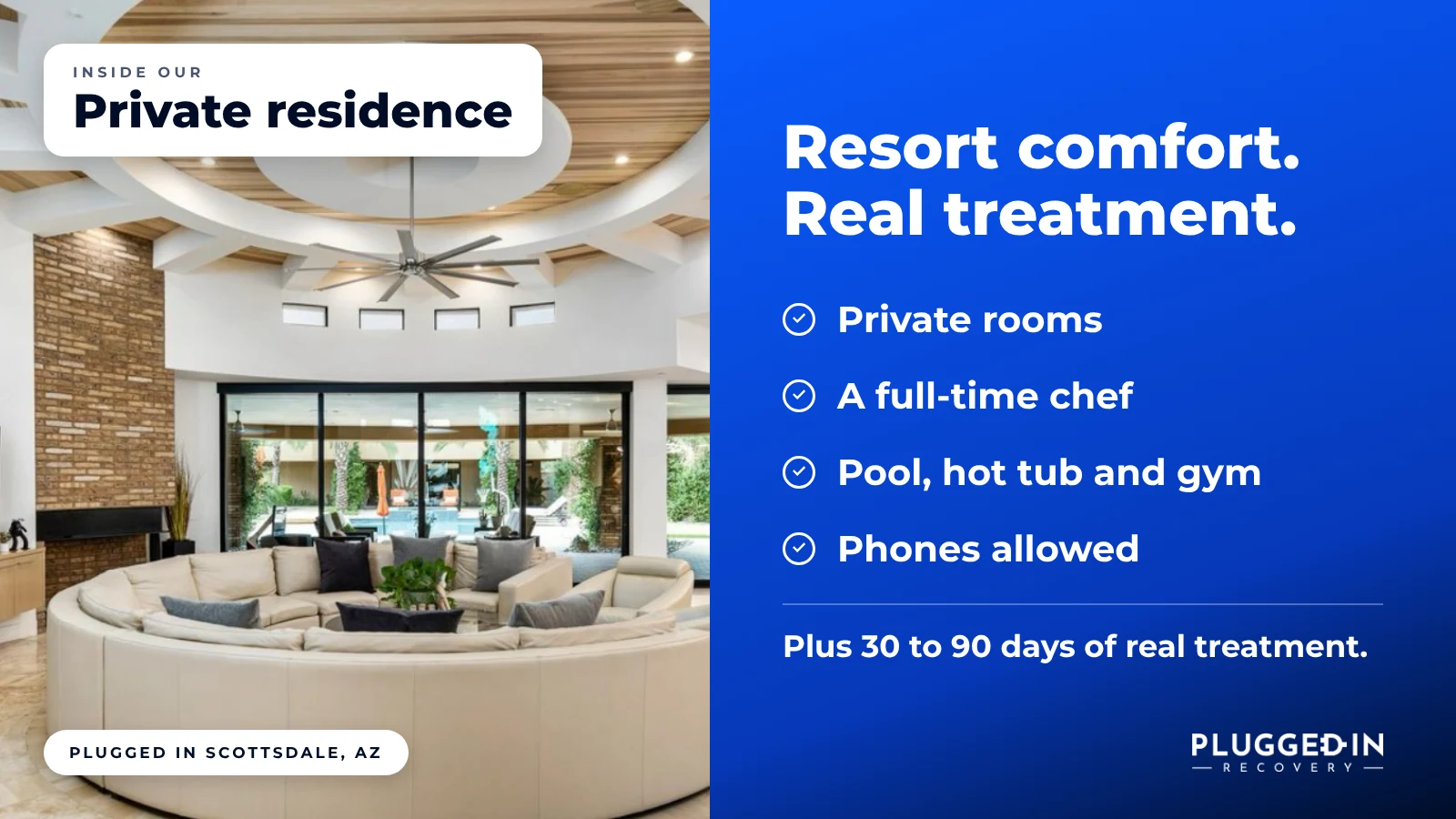
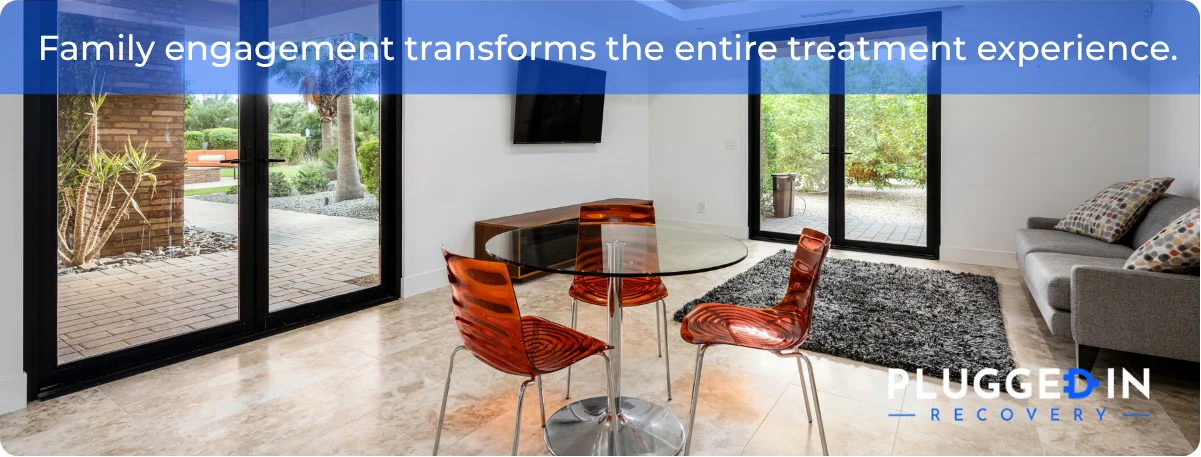
Every room at our Phoenix residence is private, with its own ensuite bathroom, a full-size bed and a TV. Our 5,725-square-foot Scottsdale home has private rooms with Tempur-Pedic queen beds and streaming on every flat-screen.
Having your own space means real sleep, and a door you can close after a hard group.
Chef-Prepared Meals
A full-time chef runs the kitchen in Scottsdale, and meals in Phoenix are chef-prepared too. Nutritional counseling is part of the program, which matters when your body has been running on alcohol or drugs instead of food.
Pool, Gym and Wellness
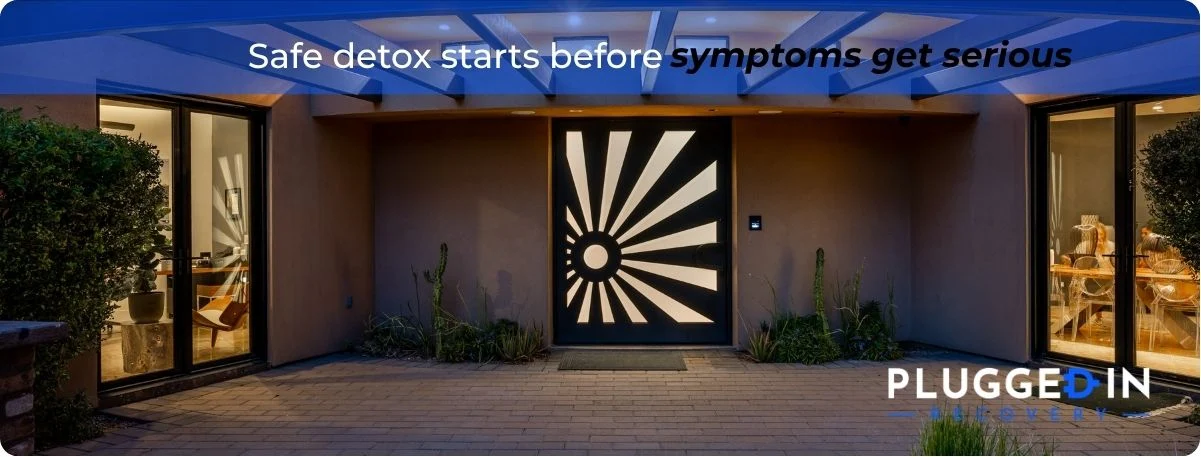
The Scottsdale residence has a full-size diving pool and hot tub, a full gym, a putting green, a firepit and an in-house movie theater. Phoenix has a zen room for quiet reflection. Both homes offer:
Yoga and meditation
Holistic wellness and spa services
Art therapy
At a resident’s request, we can also arrange massage, acupuncture, red light sauna, cold plunge, IV therapy and equine therapy by referral.
Phones and Laptops Stay With You
This is the one that surprises people. Most residential programs take your phone at the door. We don’t, and Darren doesn’t think taking it would make treatment work any better.
At the end of the day, I’m not sure there’s any real evidence that not allowing somebody to have their phone promotes a better treatment experience or a more effective treatment experience than a place that does allow people to have their phones.
Darren Lee, LPC, Clinical Director
He’s also realistic about the reason other programs lock phones away.
The idea is if people are going to have conversations with their drug dealers, or if they’re going to do some sort of gambling online, or participate in a nefarious way on their phone, then they’re going to do it.
Darren Lee, LPC, Clinical Director
For working professionals and parents, staying reachable is often what makes saying yes to treatment possible in the first place.
What a Day in Luxury Rehab Looks Like
The schedule under all of this isn’t so different from what happens in alcohol rehab at any good program. A typical weekday at our Scottsdale residence runs roughly like this:
Morning: a chef-prepared breakfast, then a check-in or process group to set goals for the day
Midday: CBT skill-building, psychoeducation and individual counseling
Afternoon: life skills, relapse prevention and experiential activities
Evening: a nightly wrap-up, peer-led meetings and, some nights, a movie in the theater
Therapy draws on CBT, DBT, ACT and trauma-informed care, and you can choose a 12-step or non-12-step path.
Stabilization Comes Before Deep Trauma Work
A common assumption is that residential treatment means opening up every painful memory right away. Darren sees the first weeks differently.
I do believe that our time is best spent stabilizing people, getting them grounded on their feet, and helping them identify, develop, and pursue a strong aftercare plan.
Darren Lee, LPC, Clinical Director
So the early work centers on getting physically and emotionally steady, building coping skills and treating anxiety or depression. Trauma isn’t ignored. Our therapists address it, and Darren is EMDR-certified. The heavier reprocessing usually comes later, once someone is stable.
Do Luxury Rehabs Work?
Short answer: the good ones do, and it has nothing to do with the thread count. A well-known JAMA review compared addiction with other long-term illnesses and found relapse rates were about the same as for high blood pressure or asthma.
Nobody calls blood pressure treatment a failure when the numbers creep back up. You adjust and keep going.
Where someone goes after treatment matters just as much.
If we take a newly recovering person and place them right back into their old environment, the likelihood of relapse is… overwhelmingly high.
Darren Lee, LPC, Clinical Director
That’s why we run luxury sober living for the step after residential care. It gives people a structured, sober home instead of sending them straight back to the old one. So when you’re asking whether a luxury rehab works, look at what it does on the way out.
If you’re still deciding about treatment at all, we wrote a separate piece on whether rehab is worth it.
Aftercare Planning Starts on Day One
At Plugged In, the conversation about life after treatment begins almost immediately.
When somebody enters treatment… the immediate focus needs to be on setting them up for success when they discharge.
Darren Lee, LPC, Clinical Director
By the second week, the clinical team is usually sketching what aftercare will need to look like. For most people that includes:
Ongoing therapy, weekly or every other week at first
Sober living when home isn’t a safe place to start
Community support, from 12-step meetings to other recovery groups
Who Luxury Rehab Is Right For
Luxury rehab isn’t the right fit for everyone, and a good admissions team will say so. For people weighing a luxury alcohol rehab in Phoenix, it tends to make the most sense for those who:
Have work or family responsibilities and want to stay reachable by phone
Are dealing with anxiety, depression or trauma alongside drinking or drug use
Have tried outpatient treatment and need more structure
Value being treated as an adult making their own decisions
Not sure which level of care fits you? Call our admissions team at 602-527-8096 and talk it through.
Luxury Rehab in Phoenix at Plugged In Recovery
Plugged In Recovery offers residential treatment at our Phoenix and Scottsdale residences, outpatient care in Chandler, and luxury sober living for the step after. Stays run 30 to 90 days based on progress, and same-day admission is available.
From our conversation with Darren Lee, Clinical Director at Plugged In Recovery.
Has anyone misused their phone at Plugged In?
Well, at Plugged In, no. It hasn’t. But it has absolutely happened at other facilities where I’ve worked that don’t allow phones. So that’s the irony of it.
Darren Lee, LPC, Clinical Director
What happens if someone misuses their phone?
If we discover it, we will put restrictions on it. So it’s not no holds barred phone usage.
Darren Lee, LPC, Clinical Director
Frequently Asked Questions
What is luxury rehab like?
Luxury rehab feels closer to a private residence than a hospital. You’ll have your own room, chef-prepared meals and a schedule that mixes individual therapy, clinical groups and wellness time, often with your phone and laptop still allowed. It’s built for rest.
What are the three types of rehab?
The three main levels are residential (inpatient), where you live on site, partial hospitalization, with full days of treatment while living at home, and intensive outpatient, a few hours a day several days a week. Luxury rehab is usually residential.
Is luxury rehab worth it?
Sometimes. It’s worth it when the treatment is as good as the house. Before you sign anything, ask who the therapists are, what methods they use, and what happens after you leave. If all you hear about is the pool and the chef, look somewhere else.
Does insurance cover luxury rehab?
Often, yes, at least partly. Marketplace plans have to cover substance use disorder treatment, and plenty of private plans pay toward residential care. What you get depends on your plan and on medical need. A free insurance check before admission will tell you.
Is rehab worth it? For most people with a moderate to severe drinking or drug problem, yes. Addiction treatment works about as well as care for other long-term conditions like high blood pressure and asthma.
Whether it pays off for you comes down to fit: the right level of care, real treatment for whatever sits underneath the substance use, and a plan for the months after you leave.
Most people asking this already know something has to change. The doubt is about the money, the weeks away from work, and whether any of it will hold once they’re back home. Each of those worries has a straight answer.
Key takeaways
A relapse means adjusting the plan, not that treatment failed.
Rehab pays off when the level of care fits your needs.
Be wary of programs with no clear therapies or aftercare plan.
Marketplace insurance plans must cover addiction treatment.
Does Rehab Work? What the Research Says
A relapse after treatment can feel like proof that it didn’t work. The research points the other way.
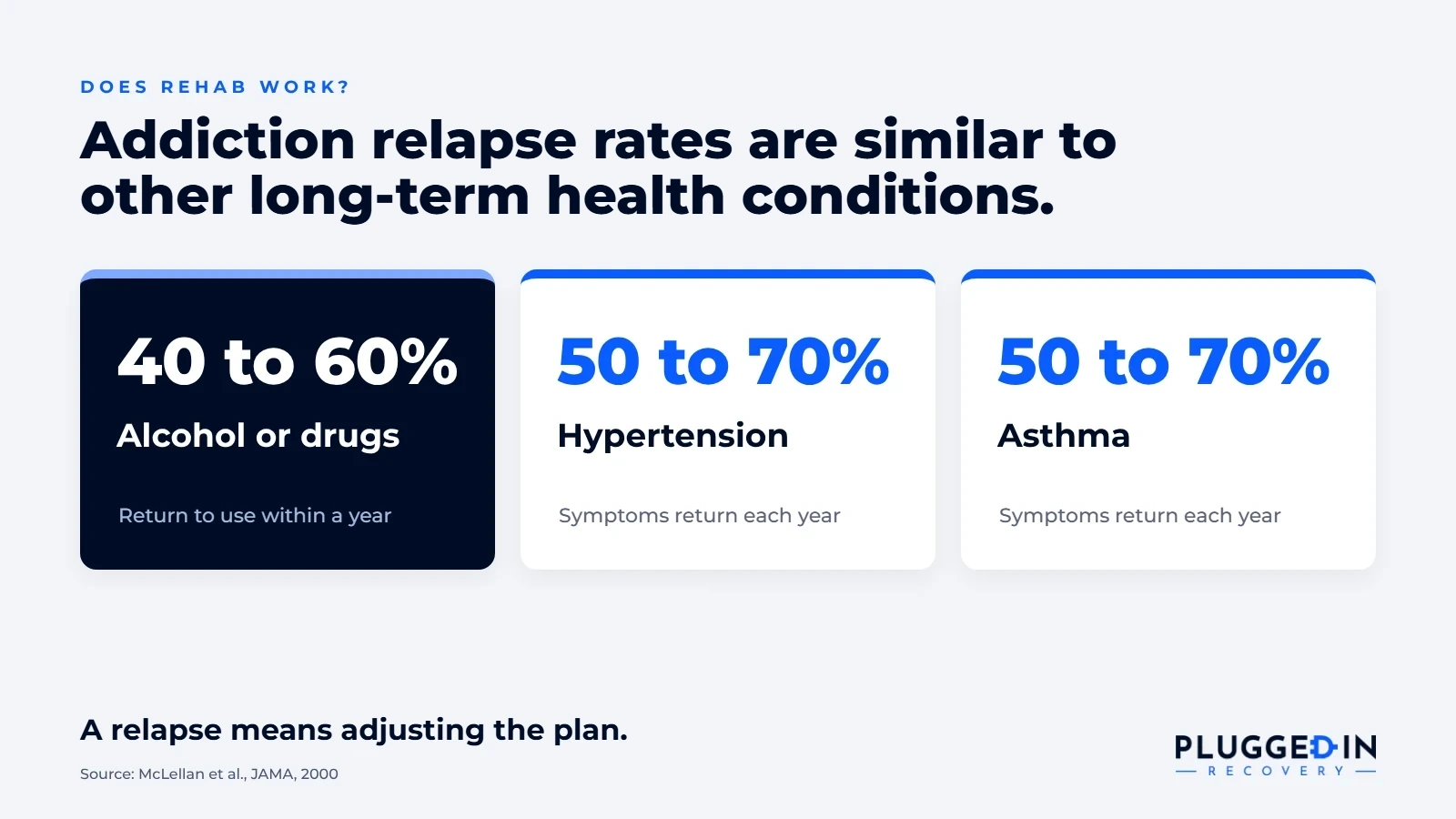
A widely cited study in JAMA found that 40 to 60% of people treated for alcohol or drug dependence return to use within a year. That’s close to the 50 to 70% of people with hypertension or asthma whose symptoms come back each year.
When someone’s blood pressure creeps back up, the fix is a new prescription, not giving up on treatment. McLellan’s team makes the same point about addiction. A relapse calls for a change to the plan and more support.
Over the long haul, the numbers look better still. The National Institute on Alcohol Abuse and Alcoholism says most people with alcohol use disorder do recover or get a lot better eventually. Plenty of them slipped once or twice on the way.
Recovery is also measured in more than days sober. In treatment, people work on:
Sleep, energy and physical health
Focus and reliability at work
Rebuilding trust at home
Handling stress without a drink or a pill
The Real Cost of Not Going to Rehab
The price of treatment is easy to see on paper. Waiting has a price too. It just shows up in pieces.
What treatment costs
What waiting costs
A planned stay, often 30 to 90 days
Months or years of slipping at work
Program fees, often partly covered by insurance
Medical care as your health takes the hit
A structured pause with clinical support
Crises on their own schedule, like ER visits or a DUI
Hard conversations, guided by a therapist
Hard conversations at home, with no one guiding them
When Rehab Is Worth It, and When It Isn’t
Rehab isn’t one thing. Whether it’s worth your money depends on two questions: is this the right level of care, and is this a good program?
Signs Residential Rehab Is the Right Level of Care
Red Flags That a Rehab Program Isn’t Worth the Money
The NIAAA suggests asking any provider direct questions before you commit. Be wary if a program:
Can’t tell you which evidence-based therapies it uses
Treats addiction but not co-occurring mental health conditions
Gives every client the same plan
Has no clear answer for what happens after discharge
Won’t explain how it handles a return to drinking
Not sure which level of care fits you? Call our admissions team at 602-527-8096 and talk it through.
What Makes Luxury Alcohol Rehab in Phoenix Worth It
The comfort is real. Phones and laptops are allowed, rooms are private, and you can choose a 12-step or non-12-step path. But what makes the stay worth it is the clinical work under it:
Stays of 30 to 90 days, based on progress rather than a fixed package
CBT, DBT and trauma-informed care in every plan
Dual diagnosis treatment, so anxiety or depression is treated alongside the drinking
People who get the most from treatment see it as the start of recovery, not the end of a problem.
Let your clinicians set the length of stay. How long alcohol rehab takes depends on your progress, and leaving early cuts the work off before it’s finished.
Plan the step-down before you leave, whether that’s outpatient care or sober living.
Bring your family in, so the people at home understand what changed.
Luxury Rehab in Phoenix at Plugged In Recovery
Plugged In Recovery offers residential treatment at our Phoenix and Scottsdale residences, outpatient care in Chandler, and luxury sober living for the step after.
If you’re still weighing whether rehab is worth it, our admissions team will listen, check your insurance and tell you honestly whether our luxury rehab in Phoenix fits what you need.
Between 40 and 60% of people treated for alcohol or drug dependence return to use within a year, about the same as symptom recurrence for asthma or high blood pressure. Over the long run, most people with alcohol use disorder recover or improve markedly.
What are the downsides of rehab?
The real costs are time away from home and work, program fees, and a few hard weeks. The bigger risk is choosing a generic program or leaving early. Either one makes it harder to get the full value of treatment.
What is the hardest part of rehab?
Usually the start. Withdrawal is still wearing off, sleep is rough, and the feelings drinking used to numb come back at once. That’s when the urge to leave can be strongest. Knowing it’s coming, and that it passes, makes it easier to stay.
Is 30 days of rehab enough?
Sometimes. Thirty days is enough for some people to get their footing. Others need 60 or 90, especially after rough withdrawal or past relapses, or with depression or anxiety in the mix. Your progress should set the length, not a fixed package.
Does insurance cover rehab?
Often, yes. Marketplace plans have to cover substance use disorder treatment. Employer plans differ, and so does how much of a residential stay they’ll pay for. A free insurance check tells you where you stand before you agree to anything.
There’s no single answer, because rehab isn’t one fixed program; it’s a sequence of stages that can run anywhere from a few weeks to several months depending on severity and what level of care follows detox.
Here’s what actually determines the timeline, and why the number matters less than the sequence.
Why There’s No Single Number
The honest answer to “how long does alcohol rehab take” is: it depends on which stage someone is starting from, and what happens after the first 30 days.
What Actually Drives the Timeline
How severe the alcohol use disorder is (mild, moderate, or severe, per DSM-5 criteria)
Whether medical detox is needed before other treatment can begin
Whether co-occurring conditions, like anxiety, depression, or trauma, need to be addressed alongside the drinking
What level of care follows residential treatment, if any
Someone with a shorter, less severe drinking history may need a very different timeline than someone with years of daily, heavy use. Neither is wrong. They’re different starting points.
Detox: The First Few Days
If detox is medically necessary, it typically comes first, before any other treatment begins.
What This Stage Usually Involves
Medical detox commonly runs 3 to 7 days, though it can extend longer depending on withdrawal severity. During this window, vitals are monitored regularly, medication manages withdrawal symptoms and lowers seizure risk, and a clinical team is present for the highest-risk period.
Not everyone needs this stage. For milder alcohol use, treatment can often begin without a separate medical detox phase.
Residential Treatment: The Core Stay
This is usually what people picture when they think of “rehab,” and it’s typically the longest single stage.
Typical Residential Timelines
Length
When it’s typically appropriate
28 to 30 days
Common minimum for stabilization and initial treatment
60 days
Often recommended when co-occurring conditions need more attention
90 days
Associated with the strongest long-term outcomes in research, especially for more severe cases
Longer stays aren’t about punishment or severity alone, they reflect how much time it actually takes to build stability, address what’s underneath the drinking, and prepare for what comes after. Rushing this stage tends to show up later as a higher relapse risk.
Step-Down Care: Where the Real Timeline Extends
This is the part people most often leave out of their mental math, and it’s often what actually determines whether treatment holds long-term.
PHP and IOP Add Real Time
After residential treatment, many people step down into a Partial Hospitalization Program (PHP) or Intensive Outpatient Program (IOP), rather than returning home immediately.
PHP typically runs 4 to 6 weeks, several days a week, full days
IOP typically runs 6 to 12 weeks, several days a week, partial days
Added to residential care, a full continuum of treatment often spans 2 to 4 months total, not the 28 days many people initially picture. This isn’t treatment taking longer than expected, it’s treatment actually matching how long behavior change takes to hold.
Why Longer Treatment Tends to Work Better
This isn’t just a sales pitch for extended care, it’s a consistent pattern in the research: longer engagement in structured treatment, including the step-down phases, is associated with better long-term outcomes than a single short stay alone.
That doesn’t mean everyone needs 90 days plus months of outpatient care. It means the length of treatment should match the severity of the situation, not an arbitrary calendar number decided in advance. If you’re not sure where you or a loved one falls on that spectrum, our article on signs you need alcohol rehab can help clarify the starting point.
What This Looks Like at Plugged In
At our Scottsdale residence, the actual length of someone’s stay is determined by an honest assessment, not a fixed program length decided before we’ve talked. Some people need 30 days and a strong outpatient plan. Others need longer residential care first. We build the timeline around the person, not the other way around.
If you’re trying to plan around a timeline, whether for work, family, or your own peace of mind, that’s exactly the kind of question worth asking directly. Call us (480) 841-9915.
Frequently Asked Questions
Is 30 days enough for alcohol rehab?
For some people with milder alcohol use disorder, 30 days of residential treatment followed by outpatient support can be enough. For more severe or long-term drinking, longer residential stays or extended outpatient care are often associated with better outcomes.
Does insurance affect how long rehab lasts?
It can. Coverage varies by plan and provider, and it’s worth verifying benefits before assuming a specific length is or isn’t affordable. Many programs work directly with insurance to determine what length of stay is covered.
What happens if I need more time than originally planned?
Treatment plans are typically reassessed regularly rather than fixed at intake. If someone needs longer than initially expected, extending residential care or moving into a more structured outpatient program is common and not a sign that treatment failed.
Do I have to do all three stages, detox, residential, and outpatient?
No. The right combination depends on individual severity. Some people don’t need medical detox at all, others benefit most from residential care without an extended outpatient phase. An assessment determines what’s actually necessary.
How soon can I start treatment once I decide to go?
This varies by facility, but many programs, including same-day intake options, can begin the process quickly once someone reaches out. The bigger time investment is usually in the treatment itself, not the wait to start.
There’s no perfect script, but there is a wrong way to do this, and it’s the way most people try first: confrontation, an ultimatum, or bringing it up mid-argument.
None of that tends to work. What helps is timing, specific language, and, in some cases, a structured approach backed by real research.
Timing Matters More Than the Words You Choose
The single most common mistake is bringing this up at the worst possible moment, mid-fight, at a family gathering, or while the person has been drinking.
When Not to Have This Conversation
While the person is intoxicated
During or right after an argument about something else
In front of a group, even well-meaning family
When you’re too angry to stay calm through their reaction
The NIAAA’s own guidance is direct on this: think through what you want to say beforehand, and consider practicing it with someone else first. Wait until the person is sober, stable, and actually capable of hearing you, not defending themselves.
What to Actually Say
Vague concern is easy to brush off. Specific observation is harder to argue with.
Describe What You’ve Seen, Not What You’ve Heard
Stick to what you personally observed, not what someone else told you or a general pattern you’ve assumed. “I noticed you seemed unsteady last night” lands differently than “everyone says you’ve been drinking too much.”
Use “I” Statements Instead of Accusations
“I’m concerned about your drinking” opens a conversation. “You have a drinking problem” tends to close one immediately. You don’t need to settle on the right label, addiction, alcohol use disorder, heavy drinking, before you can talk about specific behaviors and how they’ve affected you.
Bring Facts, Not Just Feelings
Some people respond better to information than emotion. Having a basic understanding of what alcohol use disorder actually looks like clinically can help the conversation feel less like an accusation and more like genuine concern grounded in something real.
The Approach With an Actual Track Record
If a direct conversation hasn’t worked, or you’re worried it won’t, there’s a specific method worth knowing about: CRAFT, Community Reinforcement and Family Training.
Why CRAFT Works Where Confrontation Doesn’t
CRAFT was built specifically for situations where a loved one hasn’t asked for help and may actively resist it. Rather than one confrontation, it works through everyday interactions: reinforcing sober moments together, stepping back from shielding the person from natural consequences, and approaching with curiosity instead of ultimatums.
Across clinical trials, CRAFT has engaged roughly two-thirds of treatment-refusing drinkers into actual care, substantially outperforming traditional confrontation-based approaches. That’s not a small margin; it’s the difference between a method that occasionally works and one built around real behavioral research.
What to Do If Withdrawal Is Already a Concern
If the person you’re worried about already shows signs of physical dependence, this conversation carries an added layer of urgency and caution.
Signs the Situation May Already Be Medical, Not Just Behavioral
Shakiness, sweating, nausea, or anxiety when they haven’t had a drink recently
A history of trying to quit and experiencing physical symptoms
Drinking that happens daily or almost daily over an extended period
The NIAAA estimates alcohol withdrawal accounts for roughly 260,000 emergency department visits and 850 deaths annually in the U.S. If these signs are present, don’t encourage a sudden, unsupervised stop. Our article on is it safe to detox from alcohol at home covers exactly why medical involvement matters at this stage.
After the Conversation
One conversation is rarely the whole story, and that’s normal, not a failure.
What Usually Comes Next
It may take several conversations before the person is ready to act
If they return to drinking after any period of change, responding with anger tends to deepen the cycle rather than help
Having specific next steps ready, a provider’s number, a program, matters more once someone says yes, since the window doesn’t always stay open
If the pattern you’re describing sounds like it’s moved past “too much” into something more serious, our article on signs you need alcohol rehab can help you figure out where things actually stand.
If You’re Ready to Take the Next Step Together
At our Scottsdale residence, we regularly talk with family members before the person they’re worried about ever calls, walking through exactly how to approach this conversation and what happens if they say yes.
If you’re not sure how to start, or you’ve tried and it didn’t go anywhere, a call can help. Call us (480) 841-9915
Frequently Asked Questions
What’s the best way to start the conversation about someone’s drinking?
Choose a private, sober moment and describe specific behaviors you’ve personally observed, rather than repeating what others have said. Using “I” statements, like “I’m concerned about your drinking,” tends to land better than accusatory language.
What if they get defensive or deny it?
This is common, and one conversation rarely resolves everything. Staying calm rather than escalating, and following up again later, tends to work better than pushing hard in a single sitting.
Is there a specific technique that actually works better than just talking?
CRAFT (Community Reinforcement and Family Training) is research-backed and engages roughly two-thirds of treatment-refusing individuals into care, more effectively than confrontation-based approaches. It works through consistent, everyday interactions rather than a single intervention.
Can bringing this up cause a dangerous reaction?
The conversation itself typically isn’t dangerous, but if the person has significant physical dependence, encouraging them to quit abruptly can be. If you notice withdrawal symptoms like shaking or sweating when they haven’t had a drink, medical guidance should be part of the plan.
How do I take care of myself while dealing with this?
Support groups like Al-Anon exist specifically for people in this situation. Talking to a therapist, setting boundaries, and not carrying this entirely alone all matter, this affects you too, not just the person drinking.
Alcoholism doesn’t arrive all at once. It moves through recognizable stages, from early warning signs to physical dependence to the point where drinking has taken over daily life.
Our clinical director, Darren Lee, walks through what actually separates each stage of alcoholism clinically, and why the line between them is less about how much someone drinks and more about whether they still have a choice.
Early Stage Alcoholism: When Drinking Starts Changing Shape
This stage often looks harmless from the outside, and sometimes even from the inside.
What Changes First
Drinking becomes more frequent, not just occasional
Tolerance starts building, needing more to feel the same effect
Alcohol starts serving a purpose beyond socializing: unwinding after work, managing stress, getting through a hard day
The person can usually still stop for a period of time without major difficulty
Why “Mild” Doesn’t Mean Harmless
This is also the stage where the DSM-5’s mildest classification applies, meeting 2 to 3 of the 11 diagnostic criteria for alcohol use disorder, according to the NIAAA. Mild doesn’t mean harmless. It means early enough that intervention tends to work faster and more completely than it will later in the stages of alcoholism.
Middle Stage Alcoholism: When Consequences Start Piling Up
This is where the pattern becomes harder to explain away. Consequences start showing up, missed responsibilities, strained relationships, health warnings, and the drinking continues anyway.
The Clinical Line That Actually Matters
Darren’s clinical definition of addiction centers exactly here: “continued use despite adverse consequences.” At this stage, the honest question isn’t whether the drinking is a problem, it’s whether stopping is still fully a choice.
Darren draws a sharp line using a distinction from the Big Book of Alcoholics Anonymous: a heavy drinker who gets bad news from a doctor, liver enzymes through the roof, can still stop, even though it’s hard. Someone moving into real dependence hears the same news, and “the compulsion and the obsession is at a place where, for all intents and purposes, that choice has been removed.”
The Awareness That Doesn’t Help Yet
One detail people don’t expect: at this stage, most people already know something is wrong.
Darren describes this as significant cognitive dissonance: the person is fully aware of the gap between what they’re doing and what they know is happening to them, and that awareness alone rarely translates into stopping. Knowing isn’t the same as being able to act on it.
Late Stage Alcoholism: When Life Organizes Around Drinking
By late stage, drinking isn’t one part of life anymore; it’s the organizing principle of it.
What Late Stage Actually Looks Like
Physical dependence is typically present, meaning the body has adapted to regular alcohol use
Stopping suddenly can trigger withdrawal ranging from uncomfortable to medically dangerous
Health consequences tend to compound: liver damage, cardiovascular strain, cognitive effects
Daily functioning, work, relationships, basic routines, becomes difficult to sustain
Why the Stage Matters More Than the Excuse to Wait
A lot of people wait for a moment dramatic enough to justify taking action, believing they need to hit some version of rock bottom before it’s “real” enough to act on.
Darren’s Take on Rock Bottom
“I don’t typically hear rock bottom in the context of scientific research,” Darren told us. “It’s more of a lay term, and we’ve adopted it to mean a place for that individual that finally shifts them into that space mentally and emotionally to start considering very seriously making a change.” It looks different for everyone, and for some people, it never arrives in a way anyone would recognize from the outside.
The stage someone is actually in matters more than whether they’ve hit a crisis dramatic enough to feel legitimate.
What Treatment Looks Like at Each Stage
The right level of care depends on which stage someone is actually in, not on how bad things need to look first.
Stage
What treatment typically involves
Early
Outpatient support, often IOP, focused on building new coping patterns before dependence sets in
Middle
A fuller assessment, sometimes residential, addressing both the drinking and what’s driving it
Late
Medical detox first, followed by residential treatment and a longer-term recovery plan
At our Scottsdale residence, that assessment happens honestly, not by assuming the worst or the mildest option before actually talking it through. If you’re unsure which stage applies, our article on signs you need alcohol rehab breaks down the practical markers in more depth.
If you’re seeing yourself, or someone you love, in one of these stages of alcoholism, that recognition is worth acting on now rather than waiting for the next one. Call us at (480) 841-9915
Frequently Asked Questions
How many stages of alcoholism are there?
Most clinical frameworks describe three broad stages, early, middle, and late, though severity within each stage varies significantly. The DSM-5 uses a related but separate system, classifying alcohol use disorder as mild, moderate, or severe based on the number of diagnostic criteria met.
Can someone move backward from a later stage to an earlier one?
Not without treatment. Left alone, alcoholism tends to progress rather than reverse, since the underlying dependence typically deepens over time. Recovery is possible at any stage, but it usually requires active intervention rather than time alone.
Is early-stage drinking still considered alcoholism?
Yes, if it meets diagnostic criteria. Early stage often corresponds to what’s clinically classified as mild alcohol use disorder, and it’s real, even though it’s frequently dismissed as “not that bad” by the person experiencing it.
How do I know which stage I’m actually in?
The clearest marker is whether stopping still feels like a real choice or whether the compulsion has taken over despite consequences. A professional assessment can clarify this more precisely than self-diagnosis, especially in the middle stage where the line isn’t always obvious.
Does someone need to reach the late stage before getting help?
No, and waiting often makes treatment harder, not easier. Intervention tends to work faster and more completely in earlier stages, before physical dependence and life disruption have fully set in.
At Plugged In Recovery, treatment isn’t one thing that happens to everyone the same way.
It starts with an assessment, moves through detox if it’s needed, and settles into a structured mix of therapy, medical support, and planning for what comes after.
Here’s what happens, day by day, once someone walks through our doors.
It Starts With an Honest Assessment, Not an Assumption
We don’t put everyone through the same program on day one.
Before anything else, we sit down with each person and figure out where they actually stand: how severe the drinking has become, whether medical detox is needed, what else might be going on underneath it- anxiety, depression, trauma- and what level of care actually fits.
That assessment shapes everything that follows.
If Detox Is Needed, It Comes First
Not everyone needs medical detox, but for people with heavier, longer-term drinking, it’s the necessary first step before any real therapeutic work can happen.
At Plugged In, that means vitals are monitored regularly, medication is provided to ease withdrawal symptoms and lower seizure risk, and a clinical team is present around the clock during the highest-risk window.
We don’t rush this part. If you want the full breakdown of what makes detox safe versus dangerous, our article on is it safe to detox from alcohol at home covers that in depth.
A Typical Day at Our Scottsdale Residence
Once someone’s stabilized, the day fills up fast, and that surprises a lot of people who picture rehab as a lot of downtime.
Time
What happens
Morning
Breakfast, check-in or process group
Mid-morning
Individual therapy or clinical group
Midday
Recovery groups, psychoeducation
Afternoon
Free time (gym, pool), then more individual or group sessions
Evening
Evening review, wind-down
We keep clients busy on purpose. Structured days with real clinical content, not just supervised free time, are what actually move people forward.
We don’t just talk about the drinking. We use evidence-based approaches, including CBT and DBT, individual therapy, and group work, to address what’s actually driving it.
For a lot of our patients, that includes co-occurring anxiety, depression, or trauma that’s been sitting underneath the alcohol use for years, sometimes without them realizing it.
We don’t rush into heavy trauma work in the first days either. Early treatment is about stabilization, getting grounded, building coping skills, and putting together a real aftercare plan.
Deeper trauma processing tends to come later, often once someone has a stronger foundation to work from.
Recognizing the Problem, Not Just Treating It
Part of what we do at Plugged In isn’t just clinical; it’s helping people actually see the pattern clearly, often for the first time.
We don’t tell people they’re addicts and expect that to land. Recognition happens through repeated, honest conversation, not a single confrontation, which is a big part of why lasting change tends to come from treatment rather than a private New Year’s resolution.
If you want to understand what that recognition process actually looks like, our article on signs you need alcohol rehab covers it directly.
We don’t believe stripping away someone’s independence makes treatment more effective; it just adds an adolescent-style restriction to people who are already adults making a hard decision.
We give clients the benefit of the doubt until there’s a real reason not to.
What Comes After
Rehab doesn’t end at discharge, and we don’t treat it that way. Depending on where someone lands, we help step down into PHP or IOP through our outpatient program in Chandler, so the structure that helped someone get stable doesn’t just disappear the day they leave residential care.
We also build a real aftercare plan before anyone leaves: ongoing therapy, support groups, and a relapse-prevention plan tailored to that person’s life, not a generic handout.
If you’re wondering what this would actually look like for you or someone you love, we’d rather answer that on a call than have you guess.(480) 841-9915
Frequently Asked Questions
How long does alcohol rehab last?
At Plugged In, residential stays typically run 30 to 90 days, depending on clinical need, and are often followed by a step-down into outpatient care. The right length depends on the severity of the drinking and what else is being addressed alongside it.
Do I have to do detox before starting therapy?
Only if medical detox is needed based on your drinking pattern. For people with milder use, treatment can begin without a separate detox phase. For heavier, longer-term drinking, detox typically comes first for safety.
Will I have to talk about my whole life story on day one?
No. We focus on stabilization first, not deep trauma work. Getting grounded and building coping skills comes before anything more intensive, which usually happens later once there’s a stronger foundation.
Is alcohol rehab just group therapy all day?
No. A typical day includes individual therapy, group sessions, recovery-focused programming, and unstructured time, not one continuous group session. The structure is intentional, but it’s varied.
What happens after I leave residential treatment?
We help plan the next step before you go, often a step down into PHP or IOP at our outpatient program, along with ongoing therapy and a relapse prevention plan built around your specific life, not a generic template.
Maybe you’ve already tried this. A dry month, a rule about weekdays, a promise to yourself after a bad night that didn’t survive the weekend.
Learning how to stop drinking alcohol isn’t really about willpower, and the fact that a plan didn’t stick before doesn’t mean you’re bad at this. It usually means the plan was missing something.
Here’s what actually works, and just as important, how to tell if this is something you can safely do on your own.
Can You Safely Quit on Your Own?
This is the question to answer first, because everything else depends on it.
Signs you may be able to cut back or quit without medical support
You haven’t been drinking heavily every day for an extended period
You’ve never experienced withdrawal symptoms, such as shaking, sweating, and anxiety, when you didn’t drink
You’ve successfully taken breaks from drinking before without complications
No history of seizures related to alcohol
Signs you need medical support first
Daily or near-daily heavy drinking for weeks or months
Shaking, sweating, or a racing heart within hours of your last drink
A past seizure or hallucination during a previous attempt to stop
Other health conditions that make withdrawal riskier
If the second list sounds familiar, stopping suddenly on your own isn’t a test of willpower; it’s a real medical risk.
Why the Last Attempt Probably Didn’t Fail Because of You
Here’s something worth sitting with: if you’ve tried before and it didn’t stick, that’s not proof you lack discipline.
Repeated failed attempts to cut down are actually one of the clinical markers doctors look for when assessing alcohol dependence, not a personal failing, a real sign of how alcohol dependence works.
That reframe matters, because it changes what “trying again” should actually look like. Not more willpower. A different structure.
What Actually Works, Beyond Just Deciding
The NIAAA’s Rethinking Drinking framework, one of the few genuinely evidence-based, free resources on this, points to a few things that consistently make the difference between an attempt that sticks and one that quietly dissolves by Thursday.
A number beats a feeling
“Drink less” isn’t a plan, it’s a wish. A specific number, drinks per week, a firm quit date, gives you something to actually measure against, and something harder to quietly renegotiate with yourself at 9pm.
Distance from the trigger, not just the bottle
If a specific bar, a specific hour, a specific chair on the couch is when the drink happens, removing the alcohol from the house doesn’t remove the pull. Changing the routine around the trigger tends to work better than white-knuckling through it.
What was the drink actually doing for you?
This is the part most self-help advice skips entirely. If alcohol has been how you unwind after work, how you get through a hard conversation, how you fall asleep, quitting without replacing that function is quitting with a hole left where something used to be. Naming what the drink was actually doing, stress relief, social ease, numbing, matters more than the drink itself.
Say it out loud to one person
Private goals are the easiest ones to quietly abandon, because nobody’s watching. Telling one person, a partner, a friend, a support group, a provider, turns an internal negotiation into something with a witness. That alone changes the odds.
When This Becomes More Than a Habit to Break
Sometimes “I’ll just cut back” reveals something bigger the more honestly you look at it: attempts that don’t hold, drinking that continues even when it’s clearly costing you something. That’s not you failing at moderation. It’s often the moment the goal needs to shift from cutting back to real treatment.
For people who need more than a self-directed strategy, support isn’t all-or-nothing.
Our luxury alcohol rehab program includes residential care for people who need to step fully away, and outpatient options for people who need real structure without leaving a job or family behind.
As a luxury alcohol rehab in Phoenix, we at Plugged In Recovery start by figuring out which of those actually fits, not by assuming the most intensive option is automatically the right one for everyone who calls.
If you’ve tried this on your own and it hasn’t held, that’s not a reason to try harder alone. It’s a reason to call.(480) 841-9915
Frequently Asked Questions
Can I stop drinking alcohol cold turkey on my own?
For some people with milder patterns, yes. For people with heavier, longer-term drinking, stopping suddenly can trigger dangerous withdrawal symptoms, including seizures. If you’ve been drinking heavily and regularly, check with a medical provider before quitting abruptly.
What’s the difference between cutting back and quitting completely?
Cutting back means reducing frequency or amount while continuing to drink occasionally. Quitting means full abstinence. Which is appropriate depends on the severity of the drinking pattern; some people moderate successfully, others find that any drinking reintroduces the same problems.
How long does it take to break the habit of drinking?
There’s no fixed timeline; it depends on how ingrained the pattern is and what’s replacing it. Early weeks tend to be hardest, since the routines and triggers are still fresh. Structured support, rather than willpower alone, is what most consistently makes the difference past that point.
What if I’ve tried to quit before and it didn’t work?
That’s common, and it’s meaningful information rather than a failure. Repeated unsuccessful attempts to cut down are actually one of the clinical signs of alcohol dependence, and may mean the right next step is professional support rather than another solo attempt.
Is medication available to help with quitting?
Yes, several FDA-approved medications can reduce cravings or discourage drinking, typically prescribed alongside therapy or a treatment program, not as a standalone fix. A medical provider can determine if one is appropriate.
Alcohol use disorder has a real clinical marker: continued drinking despite serious, repeated consequences.
Our clinical director at Plugged In, Darren Lee, LPC and EMDR-certified, breaks down the actual signs you need alcohol rehab, what recognition looks like at intake, and why waiting for rock bottom isn’t a strategy most people need.
How to Tell Heavy Drinking From Real Dependence
This is the distinction underneath most versions of “do I need rehab,” even when it’s not phrased that way.
Darren’s working definition: continued use despite adverse consequences. A heavy drinker can technically fit that too, up to a point.
What separates real dependence is the degree, a level of continued use in the face of consequences so consistent that it leaves everyone around that person, sometimes including the person themselves, wondering what’s actually going on.
Heavy Drinker vs. Dependence: The Actual Difference
Heavy drinker
Alcohol dependence
Can stop when given a real reason (doctor’s warning, health scare)
“The compulsion and the obsession is at a place where, for all intents and purposes, that choice has been removed”
Consequences are occasional
Consequences are chronic, and people notice
Stopping is unpleasant, but possible
Stopping alone, repeatedly, doesn’t work
Darren points to a distinction from the Big Book of Alcoholics Anonymous he still relies on clinically: a heavy drinker who gets bad news from a doctor, liver enzymes through the roof, can stop.
It won’t be easy, but the choice is still there. Someone with real dependence hears that same news and, in his words, “the compulsion and the obsession is at a place where, for all intents and purposes, that choice has been removed.”
The Clinical Checklist: DSM-5 Criteria for Alcohol Use Disorder
The NIAAA supports this clinically, using DSM-5 criteria to measure severity by the number of diagnostic markers someone meets, not simply by volume consumed. In the past 12 months, has your drinking:
Been in larger amounts or over a longer period than intended
Involved a persistent desire, or failed attempts, to cut down or stop
Taken up a great deal of time, getting alcohol, using it, or recovering from it
Involved cravings strong enough to be hard to think past
Interfered with work, school, or home responsibilities
Continued despite causing problems with people you care about
Meant giving up activities you used to enjoy
Put you in physically risky situations
Continued even after you realized it was causing a physical or mental health problem
Required more alcohol over time to get the same effect
Come with withdrawal symptoms, or drinking specifically to avoid them
What the Number Actually Means
Criteria met
Severity
2 to 3
Mild
4 to 5
Moderate
6 or more
Severe
Two is the diagnostic floor, not a high bar. That table is the clinical version. The signs you need alcohol rehab usually show up smaller and quieter than a checklist first.
The Quieter Signs Worth Taking Seriously
Beyond Darren’s core distinction, a few patterns tend to show up consistently in people who need more than willpower:
You’ve tried to quit or cut back, and it didn’t stick, more than once, even with a real reason to stop
Someone who rarely comments on your drinking has said something, because the pattern is usually visible before it feels obvious to you
You’ve minimized how much or how often when asked directly, even to people who weren’t judging you
A rule you set for yourself (“not before 5pm,” “only weekends”) has been broken more than once
You’ve had a private moment of real fear about it, even briefly, even if you talked yourself out of it by morning
None of these alone is proof of anything. Together, alongside Darren’s choice-removed distinction above, they’re usually enough to stop guessing and ask directly.
Failed Attempts to Quit Alone
If a real reason to stop, a health scare, a relationship on the line, a job at risk, hasn’t been enough to make it stick more than once, that’s not a willpower failure.
That’s the exact pattern Darren describes as the line between heavy drinking and dependence, and it’s one of the clearest signs you need alcohol rehab rather than another attempt at doing it solo.
Which raises the next question: if the pattern is already this visible, why hasn’t it clicked yet? Darren has an answer, and it comes from what he actually watches happen at intake.
What Intake Reveals That People Miss in Themselves
This is the part almost nobody expects, and it’s a big reason self-assessment alone often isn’t enough.
At our Scottsdale residence, recognition doesn’t happen at the intake desk itself. It happens shortly after, through a structured process built around AA’s Step 1: admitting powerlessness over alcohol and that life has become unmanageable. One of our staff members leads clients through it directly.
Darren’s framing of what actually works here is specific: “It’s essentially getting the person to a place where they truly recognize, I don’t love the word admit so much as recognize, that they lack the power to make the changes they want to make on their own.”
Most people walking in already have the evidence. What they’re missing isn’t information. It’s the repeated space to actually sit with it instead of explaining it away one more time.
Why “Just Telling Someone” Doesn’t Work
Darren was direct about it: “For me to say to an incoming patient, hey, it seems to make sense that you’re an addict, don’t you agree, that’s not an evidence-based, effective approach.”
A single direct confrontation, even an accurate one, tends to trigger defensiveness rather than recognition. What actually moves the needle is repeated, honest interaction over time, not a single moment of being told.
That’s worth knowing before trying to force a moment of realization, on yourself or on someone else. It usually doesn’t work that way.
You Don’t Need to Wait for Rock Bottom
A lot of people wait for a moment dramatic enough to force the issue before taking the signs seriously. Darren’s take: it’s not necessary, and it’s not even a clinical term.
“I don’t typically hear rock bottom in the context of scientific research,” he told us. “It’s more of a lay term, and we’ve adopted it to mean a place for that individual that finally shifts them into that space mentally and emotionally to start considering very seriously making a change.” It looks different for everyone, which means waiting for a specific version of it is usually just delay, not a strategy.
If more than one of the signs above already sounds familiar, that moment doesn’t need to arrive on its own.
What Treatment Looks Like Once You’ve Recognized the Signs
The right level of care depends on where things actually stand, not on how dramatic the situation needs to look first.
If this sounds like you
This is likely the right starting point
Daily life is already unmanageable
Residential treatment
You function day to day but the pattern is escalating
Outpatient (PHP or IOP)
You’ve tried quitting alone more than once
Either, starting with an assessment
You’re not sure which category you’re in
A confidential call, not a guess
As a luxury alcohol rehab in Phoenix, we start with figuring out where someone actually lands on that table, not assuming the worst or the best before talking it through.
If any of this sounds closer to your situation than you’d like to admit, that’s worth a conversation, not another week of thinking it over alone. Call us at (480) 841-9915
Ask the Clinical Director
From our conversation with Darren Lee, Clinical Director at Plugged In Recovery.
What’s the actual clinical difference between heavy drinking and real alcohol dependence?
“One of the definitions of addiction that I’ve always kind of latched onto is continued use despite adverse consequences. But an addict and an alcoholic truly does this. There’s a baffling, perplexing level of continued use in the face of ongoing, repeated, and chronic consequences. The family and the community look at that individual and just think, what in the world is going on with this individual?
The Big Book of Alcoholics Anonymous does make a distinction between the heavy drinker and the alcoholic. If presented with enough evidence, the heavy drinker can stop, even though it won’t be easy. The alcoholic simply cannot. It’s no longer a matter of choosing to stop. The compulsion and the obsession are at a place where, for all intents and purposes, that choice has been removed.”
How do you actually get someone to recognize the problem, instead of just telling them?
“For me to say to an incoming patient, hey, it seems to make sense that you’re an addict, don’t you agree, that’s not an evidence-based, effective approach. What’s effective is regularly repeating interactions with a client that promote self-reflection, so they can reach their own conclusions. It’s not at intake, but very soon after, we have a process, a Step 1 process, that’s an interactive approach with a client. It’s essentially getting the person to a place where they truly recognize, I don’t love the word admit so much as recognize, that they lack the power to make the changes they want to make on their own.”
Does someone need to hit rock bottom before they’ll accept they need help?
“No, I don’t think rock bottom is exclusive to an alcoholic. I think it’s a concept that applies to any human being, that they can come to a place that’s so unacceptable, so painful, so tragic, that whatever that looks like in the life of a person, addict or otherwise, it applies. I don’t typically hear rock bottom in the context of scientific research. It’s more of a lay term, and we’ve adopted it to mean a place for that individual that finally shifts them into that space, mentally and emotionally, to start seriously considering making a change. And it’s different for different people.”
What does Plugged In actually do once someone recognizes they need help?
At our Scottsdale residence, recognition through the Step 1 process feeds directly into a full clinical program: individual therapy, group work, and medical support if detox is needed. For people whose jobs or family responsibilities don’t allow for a full residential stay, our alcohol rehab program also includes outpatient options that provide the same clinical structure without stepping fully away from daily life.
Frequently Asked Questions
What’s the real difference between a heavy drinker and someone who needs rehab?
The difference is choice. A heavy drinker can typically stop given a real enough reason, even if it’s hard. Someone with true dependence keeps drinking despite serious, repeated consequences, because the compulsion has effectively removed that choice.
If I’ve tried to quit before and couldn’t, does that mean I need rehab?
It’s one of the clearest signs you need alcohol rehab rather than another attempt at willpower. Repeated failed attempts to stop, especially when there’s a real reason to, points toward dependence.
Why can’t I just recognize this in myself without help?
Denial isn’t usually stubbornness; it’s part of how the condition works. Clinically, what tends to break through isn’t a single confrontation, but repeated, honest conversation that lets someone reach the conclusion on their own terms.
Do I need to hit a specific rock bottom before rehab makes sense?
No. Rock bottom isn’t a clinical requirement, and waiting for a dramatic crisis before seeking help usually just delays treatment that could start sooner.
What’s the first step if this sounds like me?
A confidential conversation with a treatment provider, not a public confession or a private ultimatum. Most programs start with an assessment to determine the right level of care.
Short answer: sometimes, but not always, and for some people it’s genuinely dangerous. Alcohol is one of the few substances where withdrawal can kill you.
If you’re asking this at 2 am, googling next to someone who’s shaking, or wondering about your own body, the real answer depends on specifics, not a blanket yes or no.
When Home Alcohol Detox Is Actually Safe
Maybe this started as a plan. Cut back, tough it out over a weekend, be done with it by Monday.
That instinct isn’t crazy. A 2024 systematic review on home-based alcohol detox actually backs it up, for some people. Home detox can be safe and effective for those without severe withdrawal symptoms, as long as there’s a stable environment, regular check-ins, and no history of complicated withdrawal.
But that same review is just as clear about the other half: anyone with more severe symptoms, hallucinations, heavy shaking, or a history of seizures needs inpatient care, not willpower.
Mild vs. Severe Alcohol Withdrawal: How to Tell the Difference
Not every symptom means the same level of risk. Here’s the actual split:
Mild withdrawal
Severe withdrawal
Anxiety, irritability
Hallucinations (seeing or hearing things)
Mild shaking or sweating
Seizures, or a history of past withdrawal seizures
Trouble sleeping
Confusion or disorientation
Nausea, loss of appetite
Racing heart, high blood pressure
Usually manageable with rest and check-ins
Requires medical supervision, not home management
When asking, “Is it safe to detox from alcohol at home?” the symptoms in each column matter. If everything sits in the left column, home detox with a doctor checking in may genuinely be appropriate. If anything in the right column appears, it is no longer a home situation; it is a medical one
Why Alcohol Withdrawal Is More Dangerous Than Other Withdrawals
Your body adjusts to regular heavy drinking by quietly rebalancing its own chemistry. Stop suddenly, and that balance doesn’t correct itself gently.
Alcohol Withdrawal Seizure and Delirium Tremens Risk, by the Numbers
Seizure risk peaks 24 to 36 hours after the last drink
Delirium tremens, the most severe stage, peaks 48 to 72 hours in
DTs can be fatal without treatment
That’s not scare language. That’s just what happens in a meaningful share of cases, which is exactly why guessing is the wrong strategy here.
Signs You Shouldn’t Detox From Alcohol at Home
When wondering, is it safe to detox from alcohol at home? Here’s a gut check that matters more than a generic symptom list,
Have you been drinking daily, or close to it, for weeks or months?
Has your hand shaken or your heart raced within hours of your last drink?
Has quitting or cutting back ever caused a seizure, even once, even years ago?
Have you ever seen or heard things that weren’t there while withdrawing?
Do you have a heart condition, liver damage, or are you over 60?
One yes doesn’t mean automatic danger. Multiple yeses, especially the seizure or hallucination ones, mean you’re in the group the research says needs supervision, not the group it says is fine to manage alone.
If more than one of those hit close, that’s worth a call before it becomes an emergency: Call us at (602) 527-8096
Alcohol Withdrawal Timeline: Hour by Hour
Hours since last drink
What can happen
6 to 12 hours
Anxiety, shaking, sweating, nausea
24 to 36 hours
Highest risk window for seizures
48 to 72 hours
Highest risk window for delirium tremens
Days 4 to 7
Symptoms usually easing, but not always
That window between 24 and 72 hours is where people consistently get caught off guard.
Someone can look fine at hour 10 and be in real trouble by hour 30. That unpredictability, more than the drinking itself, is the actual argument for supervision.
What Home Alcohol Detox Can and Can’t Handle
For someone with a lighter, shorter-term pattern, mild anxiety, some shakiness, a few bad nights of sleep, home detox with a doctor checking in can genuinely be the right call. The research backs that.
What a living room can’t do is respond to a seizure at 3 am. There’s no IV for dehydration, no medication to blunt DTs, nobody watching vitals while the rest of the house sleeps. Medically supervised detox exists for that window specifically, and the honest problem is nobody can promise in advance which version of withdrawal they’re going to get.
Our alcohol rehab program starts every intake with an honest look at where someone actually falls on that risk scale, not an assumption in either direction.
What Medical Alcohol Detox Actually Involves
It’s not supervision for its own sake. It typically means vitals monitored around the clock, medication that lowers seizure risk and eases symptoms, and a clinical team that responds the moment something shifts instead of hoping it resolves.
At our Scottsdale residence, detox is the first phase of a longer process, not a standalone stop. What happens medically in those first few days directly informs the therapy and stabilization that follow.
If you’re weighing whether this is something to ride out alone or something that needs support, that question is worth asking out loud. Call us at (602) 527-8096
Frequently Asked Questions About Alcohol Detox at Home
How long does alcohol withdrawal actually last?
Symptoms typically start 6 to 24 hours after the last drink, with seizure risk peaking around 24 to 36 hours and delirium tremens risk peaking around 48 to 72 hours. Most symptoms ease within a week, though some people experience lingering anxiety or sleep issues for weeks after.
What if I just taper down slowly instead of quitting all at once?
Tapering with medical guidance can lower risk for some people. Doing it entirely alone can still go wrong if dependence is heavier than expected, so a conversation with a provider before starting is the safer move either way.
Can you actually die from alcohol withdrawal?
Yes. Delirium tremens, the most severe stage, carries a real risk of death without treatment, and alcohol withdrawal seizures occur in roughly 1 in 10 people going through withdrawal.
What are the real red flags that mean I shouldn’t try this at home?
A racing heart, visible shaking, confusion, hallucinations, or any past seizure during withdrawal. Long-term daily drinking also raises risk significantly, even if someone feels okay right now.
What do I do if withdrawal symptoms are already severe?
Confusion, seizures, hallucinations, or a heart rate that keeps climbing is a medical emergency. Call 911 or get to an ER immediately. Don’t wait to see if it passes.
When to Reach Out
If stress is no longer temporary, and it’s starting to shape how you eat, sleep, think, or function, it’s time to reach out. You don’t have to wait until it’s a crisis.
Plugged In Recovery offers luxury treatment programs that support both addiction and mental health challenges, including anxiety disorders. We’re here to help you feel grounded, understood, and supported every step of the way.
Yes, in most cases you can go to rehab and keep your job. FMLA and ADA protections cover eligible employees seeking alcohol treatment; your employer isn’t entitled to know why you’re on leave, and outpatient programs exist specifically so treatment doesn’t mean choosing between recovery and your paycheck.
The law answers half this question. The other half is what you actually say to your manager on a Monday morning, and that’s the part most articles skip.
What You’re Actually Afraid Of
It’s rarely the law itself. It’s the conversation.
People put off calling for treatment for months, sometimes years, because they can’t picture how to explain a gap on the calendar without the word “rehab” leaving their mouth in a meeting. That fear is legitimate. It’s also solvable with almost no disclosure at all.
What to actually say
You don’t need to say anything about alcohol. A version that works in almost any workplace: “I have a medical situation I need to take leave for. I’ll have documentation from my provider, and I’d like to talk through timing so we can cover my responsibilities.” That’s it. HR processes leave requests on medical necessity, not diagnosis, every day.
If a manager pushes for more, the honest answer is still simple: “It’s a private medical matter, and I’ll have what HR needs.” You’re not obligated to elaborate, and pushing past that line from a manager is itself a problem HR exists to handle.
What the Law Actually Protects
FMLA gives eligible employees up to 12 weeks of unpaid, job-protected leave for a serious health condition, and the U.S. Department of Labor explicitly recognizes substance use treatment as a qualifying condition. You need 12 months with your employer, at least 1,250 hours worked in that period, and a company with 50 or more employees within 75 miles.
ADA requires employers to consider reasonable accommodations, like a modified schedule for outpatient care, for employees in treatment or recovery from alcohol use disorder, according to the ADA National Network. It protects you once you’re seeking help. It doesn’t protect someone actively impaired on the job.
If you don’t qualify for FMLA
Not everyone hits the 50-employee or 12-month threshold, and that’s a real gap worth naming instead of glossing over.
If FMLA doesn’t apply to you, options still exist: short-term disability through your employer if it’s offered, unpaid personal leave negotiated directly with a manager, or, for smaller companies, an informal arrangement built around an outpatient schedule that doesn’t require a leave at all. T
his is exactly the kind of situation worth walking through on a call, because the right answer depends entirely on your specific employer.
Which Program Actually Fits Around Your Job
Level of care
Schedule
Realistic while working?
Residential
24/7, 30 to 90 days
No, this is full-time treatment
PHP
5 days a week, full days
Difficult, most people take leave
IOP
3 days a week, half days
Yes, built for this
If daily life, including work, has already become unmanageable, residential treatment is usually the honest starting point, and FMLA leave is what covers that time away.
If you’re catching this earlier, outpatient treatment in Chandler is built around people who need real clinical support without stepping away from work entirely.
IOP runs three half-days a week: a check-in, group therapy, individual therapy, and case management. You go home every night. You go to work on your off days. Nobody at your office needs to know it’s happening at all.
What Your Employer Actually Gets to Know
Nothing, unless you sign a release. Not the diagnosis, not the program name, not whether you’re a client here. If HR needs documentation for leave, general medical paperwork covers it without naming the treatment.
If your workplace requires nothing more than a provider’s note confirming medical necessity, that’s exactly what gets sent.
The version of this question worth asking isn’t “will I lose my job.” It’s “what does this actually look like for my specific employer, my specific role, my specific situation?”
That’s not a question a legal fact sheet can answer, and it’s not one you should have to answer alone. A confidential call with our alcohol rehab program walks through your actual schedule, not a generic one.
Frequently Asked Questions
Do I have to tell my employer it’s rehab specifically?
No. You can request leave for “a serious health condition” without naming addiction treatment. HR typically processes this off a provider’s certification of medical necessity, not a diagnosis.
Can I be fired for going to rehab?
Not for seeking treatment. You can still be held to normal performance and conduct standards, including any drug and alcohol policy already in place, but entering treatment isn’t legal grounds for termination.
What if my company is too small to be subject to FMLA?
FMLA requires 50 or more employees within 75 miles. Below that, you don’t have federal leave protection, but ADA accommodation requirements may still apply, and many smaller employers will informally accommodate an outpatient schedule if you ask directly rather than assuming the answer is no.
Will my coworkers find out I’m in treatment?
Only if you tell them, or someone you told does. Treatment centers cannot disclose your enrollment to anyone, including an employer calling to verify, without your signed release.
What’s the real difference between PHP and IOP if I have to keep working?
PHP is five full days a week and functionally requires leave. IOP is three half-days a week, specifically structured so people can keep working, and is where most working professionals land if residential isn’t necessary.
When to Reach Out
If stress is no longer temporary, and it’s starting to shape how you eat, sleep, think, or function, it’s time to reach out. You don’t have to wait until it’s a crisis.
Plugged In Recovery offers luxury treatment programs that support both addiction and mental health challenges, including anxiety disorders. We’re here to help you feel grounded, understood, and supported every step of the way.
When a loved one is struggling with alcohol dependency, the entire family unit suffers. Families often carry immense trauma from past relapses, broken promises, and the sheer exhaustion of trying to manage someone else’s behavior. A common question we hear is how to help an alcoholic family member without enabling them or pushing them further away.
For years, pop culture has taught families that they need to stage dramatic confrontations or wait for their loved one to hit “rock bottom.” Clinical research paints a very different picture.
Laura Zsako, our Primary Residential Therapist at Plugged In Recovery, explains what effective family support actually looks like within our clinical model. By looking at evidence-based practices and moving past outdated advice, we provide families with practical steps they can take today.
Why Traditional Confrontations Often Backfire
Many families feel pressured to stage a surprise intervention, often relying heavily on confrontation, ultimatums, and shame. When an individual with a substance use disorder is backed into a corner and confronted by an angry group of relatives, their natural psychological response is extreme defensiveness.
Laura emphasizes how damaging negative confrontation can be for someone who is already struggling. “They have family and friends that are like, ‘You, excuse my language, you messed up. I am disappointed in you.’ That is the worst thing that you can hear is I am disappointed in you.”
Instead of motivating change, this often results in the individual isolating themselves further, making treatment even less likely and is not how to help an alcoholic family member.
If you are unsure of the best way to support your family member, our clinical admissions team is here to guide you through a free and confidential conversation at (602) 527-8096.
The Research Behind What Actually Works
The clinical standard for family involvement is the Community Reinforcement and Family Training (CRAFT) model. This approach is positive and motivational, helping friends and family work smarter to support someone suffering from substance use problems.
Instead of confrontation, CRAFT builds on principles of positive reinforcement. Families learn how to help an alcoholic family member by rewarding sober activities and discouraging activities that include drugs or alcohol. The model also teaches families to allow natural consequences, such as not calling in sick for a loved one the day after they stay up drinking.
Research has shown that seven out of ten family members who participate in the CRAFT program are successful in engaging their loved one into a treatment program. Furthermore, CRAFT participants report lower levels of anger, anxiety, and depression, independent of whether or not their loved one gets help.
Navigating Boundaries and Relapse
Relapse is terrifying for families, but how you respond sets the tone for the next steps in recovery. It requires balancing deep support with firm clinical boundaries.
Laura shares a recent experience with a family navigating this exact crisis. “His mom reached out to me and said, ‘Hey, my son relapsed. We built a connection with you… you were the only person that I knew to call that wouldn’t make me feel like crap.’ I wanted to make sure that I supported her as well as a mom, too, right? And I stepped back and I said, ‘I know this is your pride and joy,’ right? But I think it is having those hard conversations too of putting in boundaries, having healthy communication, and getting them back into treatment.”
Part of establishing those boundaries is accepting the reality of personal readiness. Families cannot force recovery.
“I told the mom who reached out to me, she said, ‘Oh, well, can’t you just come pick him up?’ And I said, ‘Um, I am hearing you, no.’ No, I can’t do that,” Laura explains. “But he has to want it. If he doesn’t want it, then maybe this isn’t the right time. I can want it till I am blue in the face, right, but at the same point too, he has to want it.”
To help your loved one access the care they need without added financial stress, you can securely verify their policy benefits with us discretely and confidentially.
Integrating Family into the Plugged In Model
At Plugged In Recovery, we do not view family therapy as an optional feature. It is a core component of how we build lasting stability. Our luxury alcohol rehab in Phoenix allows for a highly personalized, community-focused approach.
“I think having 10 beds is awesome because we get the opportunity, everybody knows everybody,” Laura says. “It is a very family-oriented small town kind of mantra.”
Families sometimes misunderstand the rigorous nature of our luxury center, assuming their loved one is simply relaxing. Laura is quick to correct this misconception. “I will get family members go, ‘Oh, well man, they are at a resort, why haven’t I heard from my loved one?’ And I was like, ‘Well let me tell you they are not just tanning.’ We keep the clients busy from 7:30 in the morning till 8:30 at night.”
We educate loved ones on the exact tools the patient is learning, ensuring that when the patient eventually steps down into our outpatient alcohol rehab in Phoenix, they are returning to a home environment that speaks the same clinical language.
Comparing Family Support Strategies
Support Model
Primary Strategy
Clinical Effectiveness
Traditional Intervention
Surprise confrontation and ultimatums
Often leads to defensiveness and treatment refusal
Complete Detachment
Disengaging until the individual seeks help
Leaves the family waiting passively for a breaking point
CRAFT Model
Positive reinforcement and strategic communication
Highly effective at engaging resistant individuals into treatment
Rebuilding Your Family Foundation Together
Watching a loved one battle an alcohol use disorder is an exhausting, traumatic experience for the entire family. You do not have to navigate this complicated clinical journey alone. Our dedicated team provides evidence-based family support alongside our exceptional patient care in a luxury alcohol rehab in Phoenix.
The constant cycle of anxiety takes a heavy toll on everyone involved. However, you absolutely do not have to navigate this complicated clinical journey by yourself. If you are ready to explore the next steps, we’re here to help you through this difficult time.
Laura Zsako Q&A
Why haven’t I heard from my loved one if they are at a luxury facility?
“A lot of times I will get family members go, ‘Oh, well man, they are at a resort, why haven’t I heard from my loved one?’ And I was like, ‘Well let me tell you they are not just tanning.’ I mean yes they have like an hour from 3:30 to 4:30 as like their free time, but I think what happens is within this beautiful facility we also are doing some really, really strong clinical groups.”
What should families understand about the daily schedule during residential treatment?
“I try to explain to family members and or friends or their employers with saying even though it looks pretty, we are here basically we keep the clients busy from 7:30 in the morning till 8:30 at night. They are in group therapy twice a week, they have recovery groups, they have in house meetings that we keep them pretty busy with, they have individual therapy.”
How does a small facility size actually benefit my family member?
“I think having 10 beds is awesome because we get the opportunity, everybody knows everybody. It is a very family oriented small town kind of mantra. It really gives them the opportunity to one open up a little bit more so because it is a smaller group. Two, to kind of help each other hold each other accountable clinically from a sobriety standpoint, mentally, physically.”
Why does my loved one insist they are fine when the family knows they need help?
“I validate them without assuming that they are fine because I sit across from clients all day every day and they are like, ‘Oh, I am fine.’ I am like, ‘Then why are you here? Let’s switch spots, you know.’ When they are high functioning they are trying to high overachieve, so what happens clinically, they mask anxiety. They mask depression. Most of them are like, ‘I want to be perfect,’ and I was like, ‘Help me help you with that.’”
What happens when the underlying issues start to surface during treatment?
“Usually around that fourteenth to fifteenth day, anxiety is coming out. Depressive mood is coming out. Sometimes they will isolate, sometimes they will cry out of nowhere, sometimes they will have a panic attack, sometimes their sleep is affected. I am constantly talking to the medical team, the doctor or psych, and saying, ‘Hey, this person is not getting any sleep, what can we do from a chemical imbalance standpoint to balance that out?’”
Frequently Asked Questions
Is family therapy covered by my insurance policy? Yes, family therapy sessions that are conducted as a component of the patient’s primary substance abuse treatment plan are generally covered by major commercial health insurance policies. Our admissions team handles the complete verification process to ensure your family understands the specific behavioral health benefits available to you before treatment begins.
How can I help an alcoholic family member who refuses to go to treatment? The most effective way to help a resistant family member is to change your own approach. Seeking guidance from a licensed therapist trained in the CRAFT model can teach you how to use positive reinforcement and improve communication. These evidence-based strategies are specifically designed to motivate treatment-resistant individuals.
When are families allowed to visit the residential facility? To ensure the safety, privacy, and clinical focus of all patients, visitation is highly structured. We typically ask families to wait until the patient has completed their initial stabilization and medical detox phase before scheduling on-site visits. Your primary therapist will coordinate visitation times that align with the patient’s treatment milestones.
What happens if the home environment is not supportive of recovery? If a patient’s primary residence is unstable or heavily triggering, returning home immediately after residential care is not recommended. In these instances, our clinical team assists families in arranging for the patient to transition into a reputable sober living home while they participate in our intensive outpatient program.
Spouse Observation Checklist
Recognizing the Shift in Your Partner
Noticeable increase in alcohol tolerance over the last twelve months.
Intense defensiveness when the topic of drinking is casually mentioned.
Drinking occurs in isolation or after the rest of the household is asleep.
Consistent failure to remember conversations that occurred late in the evening.
Visible morning anxiety that only subsides as the workday progresses.
Alcohol withdrawal usually starts 6 to 12 hours after your last drink. It begins with mild discomfort. For some, it can build to seizures or even a life-threatening state called delirium tremens.
Most people land on the uncomfortable but manageable side. The real risk is for those who have been drinking heavily for a long time. For them, stopping without medical help can be dangerous.
The most useful thing you can get from this page is knowing where you stand and what to watch for. If your symptoms are getting worse, do not wait. Get medical help now.
Why Alcohol Withdrawal Happens
Heavy drinking over time changes the brain. It turns down its calming signals and cranks up the ones that keep you alert. That is why stopping feels so rough.
Take away the alcohol, and the brain is left running hot. The nervous system goes into overdrive. That is what causes withdrawal, from the early shakes and anxiety to the more serious symptoms that can come later.
This is why alcohol is one of the few drugs where withdrawal alone can be deadly if you do not have medical help.
Alcohol Withdrawal Symptoms by Stage
Symptoms do not show up all at once. They follow a timeline. Knowing what is normal at each stage, and what is not, matters.
Stage
Timing
Symptoms
Mild
6 to 24 hours after last drink
Headache, nausea, anxiety, hand tremors, sweating, insomnia, heart palpitations
According to NCBI’s clinical review on alcohol withdrawal syndrome, symptoms typically peak around 72 hours and reflect the heightened excitatory state the brain enters when alcohol is removed after a prolonged period of heavy use.
A note on the severe stage: delirium tremens affects around 3 to 5 percent of people going through withdrawal. Without medical treatment, it carries a mortality rate of up to 15 percent. With proper medical supervision, that number drops below 1 percent. The gap between those two outcomes is the reason medically supervised detox exists.
The Symptoms Most People Do Not Expect
Most people picture shaking and sweating when they think of withdrawal. That happens, but there are other symptoms that catch people off guard, especially the first time.
Anxiety that feels physical. This is not ordinary worry. It can hit as a wave of dread, racing heart, short breath, a sense that something terrible is about to happen. It can feel like a panic attack or even a heart problem. It is neither. It is your brain reacting to the lack of alcohol.
Hallucinations in the moderate stage. Auditory and visual hallucinations can occur as early as 24 hours after the last drink, well before the severe stage. These are called alcoholic hallucinosis and are distinct from the hallucinations of delirium tremens – they occur in an otherwise alert person. They are alarming but not always a sign that DTs are coming.
Insomnia that sticks around. Trouble sleeping is common in withdrawal. What most people do not expect is how long it can last. After the first week, some people still have insomnia, mood swings, and anxiety for weeks or even months. This is called Post-Acute Withdrawal Syndrome, and it is a big reason people relapse. Ongoing support after detox makes a difference.
Who Is at Highest Risk for Severe Withdrawal
Not everyone is at the same risk. Severe withdrawal, seizures and delirium tremens, happens most often in people who:
Have been drinking heavily every day for years, not months
Have gone through alcohol withdrawal before, especially if they had a seizure
Have previously experienced delirium tremens
Are older, or have liver, heart, or kidney conditions
Stopped drinking abruptly rather than gradually reducing
If any of these sound like you or someone you care about, medical supervision is not optional. It is the standard. The risk of serious problems goes up with each withdrawal and with how long and how much you have been drinking.
If you are not sure where you fit, that is reason enough to talk to a clinical team before you stop.
What Medical Supervision Actually Does
Medical detox is not just about comfort. It changes the risk at every stage.
In the early stages, clinical staff watch for signs that things are getting worse. If symptoms get severe, medication can prevent seizures and keep your heart stable. With 24-hour care, help is there right away if you need it.
Plugged In Recovery’s alcohol detox in Phoenix is built for this. You get clinical monitoring through the highest-risk period, in a private 10-bed setting in Scottsdale. Same-day intake is available.
If your withdrawal is less severe, the Chandler outpatient program gives you structure and medical oversight without a stay. Both programs take most major insurance.
If you want to know what full treatment looks like before you decide, Plugged In Recovery’s alcohol rehab in Phoenix walks you through residential care from start to finish.
If You Are Planning to Stop or Have Already Withdrawn
Alcohol withdrawal follows a pattern. Knowing it helps. But for people with strong physical dependence, knowing the pattern does not change the risk.
If you are planning to stop and have been drinking heavily for a long time, talk to a clinical team first. Do not go it alone. A quick assessment will show what kind of support you need and whether outpatient or residential detox is safer for you.
The Plugged In Recovery’s admissions team in Phoenix is ready for a confidential conversation. If you need to start right away, same-day intake is available. Getting help does not have to be complicated. It starts with one call about what safe stopping looks like for you.
FAQ
What are the first signs of alcohol withdrawal?
Tremors, sweating, nausea, headache, and anxiety – usually within 6 to 12 hours of the last drink. Uncomfortable but rarely dangerous at this stage. In people with a long history of heavy drinking, symptoms can escalate quickly from here.
How long do alcohol withdrawal symptoms last?
Most people see the worst symptoms peak at 48 to 72 hours and resolve within a week. Post-Acute Withdrawal Syndrome – anxiety, sleep problems, mood changes – can follow for weeks to months and is one of the most common drivers of relapse.
Can alcohol withdrawal kill you?
Yes. Delirium tremens affects 3 to 5 percent of people in withdrawal and carries a mortality rate of up to 15 percent without treatment. With medical supervision that drops below 1 percent. Anyone with a long drinking history or prior withdrawal seizures should not stop without medical support.
What does alcohol withdrawal feel like?
Most people describe it as a severe flu combined with anxiety that feels physical – racing heart, sweating, a sense of dread that is hard to shake. As it progresses, confusion and in some cases hallucinations can develop. How intense it gets depends heavily on how long and how much someone has been drinking.
When to Reach Out
If stress is no longer temporary, and it’s starting to shape how you eat, sleep, think, or function, it’s time to reach out. You don’t have to wait until it’s a crisis.
Plugged In Recovery offers luxury treatment programs that support both addiction and mental health challenges, including anxiety disorders. We’re here to help you feel grounded, understood, and supported every step of the way.