When a loved one is struggling with alcohol dependency, the entire family unit suffers. Families often carry immense trauma from past relapses, broken promises, and the sheer exhaustion of trying to manage someone else’s behavior. A common question we hear is how to help an alcoholic family member without enabling them or pushing them further away.
For years, pop culture has taught families that they need to stage dramatic confrontations or wait for their loved one to hit “rock bottom.” Clinical research paints a very different picture.
Laura Zsako, our Primary Residential Therapist at Plugged In Recovery, explains what effective family support actually looks like within our clinical model. By looking at evidence-based practices and moving past outdated advice, we provide families with practical steps they can take today.
Why Traditional Confrontations Often Backfire
Many families feel pressured to stage a surprise intervention, often relying heavily on confrontation, ultimatums, and shame. When an individual with a substance use disorder is backed into a corner and confronted by an angry group of relatives, their natural psychological response is extreme defensiveness.
Laura emphasizes how damaging negative confrontation can be for someone who is already struggling. “They have family and friends that are like, ‘You, excuse my language, you messed up. I am disappointed in you.’ That is the worst thing that you can hear is I am disappointed in you.”
Instead of motivating change, this often results in the individual isolating themselves further, making treatment even less likely and is not how to help an alcoholic family member.
If you are unsure of the best way to support your family member, our clinical admissions team is here to guide you through a free and confidential conversation at (480) 841-9915.

The Research Behind What Actually Works
The clinical standard for family involvement is the Community Reinforcement and Family Training (CRAFT) model. This approach is positive and motivational, helping friends and family work smarter to support someone suffering from substance use problems.
Instead of confrontation, CRAFT builds on principles of positive reinforcement. Families learn how to help an alcoholic family member by rewarding sober activities and discouraging activities that include drugs or alcohol. The model also teaches families to allow natural consequences, such as not calling in sick for a loved one the day after they stay up drinking.
Research has shown that seven out of ten family members who participate in the CRAFT program are successful in engaging their loved one into a treatment program. Furthermore, CRAFT participants report lower levels of anger, anxiety, and depression, independent of whether or not their loved one gets help.
Navigating Boundaries and Relapse
Relapse is terrifying for families, but how you respond sets the tone for the next steps in recovery. It requires balancing deep support with firm clinical boundaries.
Laura shares a recent experience with a family navigating this exact crisis. “His mom reached out to me and said, ‘Hey, my son relapsed. We built a connection with you… you were the only person that I knew to call that wouldn’t make me feel like crap.’ I wanted to make sure that I supported her as well as a mom, too, right? And I stepped back and I said, ‘I know this is your pride and joy,’ right? But I think it is having those hard conversations too of putting in boundaries, having healthy communication, and getting them back into treatment.”
Part of establishing those boundaries is accepting the reality of personal readiness. Families cannot force recovery.
“I told the mom who reached out to me, she said, ‘Oh, well, can’t you just come pick him up?’ And I said, ‘Um, I am hearing you, no.’ No, I can’t do that,” Laura explains. “But he has to want it. If he doesn’t want it, then maybe this isn’t the right time. I can want it till I am blue in the face, right, but at the same point too, he has to want it.”
To help your loved one access the care they need without added financial stress, you can securely verify their policy benefits with us discretely and confidentially.
Integrating Family into the Plugged In Model
At Plugged In Recovery, we do not view family therapy as an optional feature. It is a core component of how we build lasting stability. Our luxury alcohol rehab in Phoenix allows for a highly personalized, community-focused approach.
“I think having 10 beds is awesome because we get the opportunity, everybody knows everybody,” Laura says. “It is a very family-oriented small town kind of mantra.”
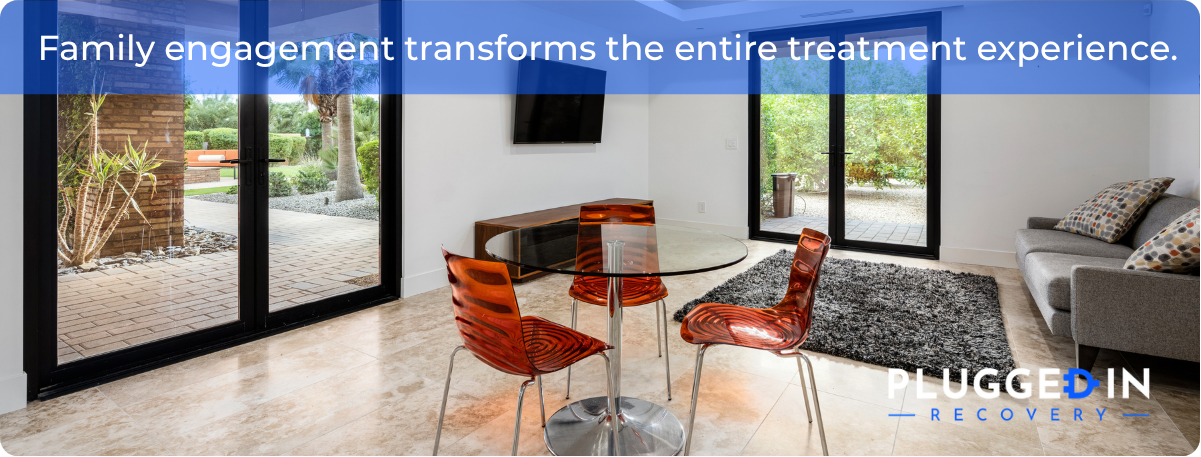
Families sometimes misunderstand the rigorous nature of our luxury center, assuming their loved one is simply relaxing. Laura is quick to correct this misconception. “I will get family members go, ‘Oh, well man, they are at a resort, why haven’t I heard from my loved one?’ And I was like, ‘Well let me tell you they are not just tanning.’ We keep the clients busy from 7:30 in the morning till 8:30 at night.”
We educate loved ones on the exact tools the patient is learning, ensuring that when the patient eventually steps down into our outpatient alcohol rehab in Phoenix, they are returning to a home environment that speaks the same clinical language.
Comparing Family Support Strategies
| Support Model | Primary Strategy | Clinical Effectiveness |
| Traditional Intervention | Surprise confrontation and ultimatums | Often leads to defensiveness and treatment refusal |
| Complete Detachment | Disengaging until the individual seeks help | Leaves the family waiting passively for a breaking point |
| CRAFT Model | Positive reinforcement and strategic communication | Highly effective at engaging resistant individuals into treatment |
Rebuilding Your Family Foundation Together
Watching a loved one battle an alcohol use disorder is an exhausting, traumatic experience for the entire family. You do not have to navigate this complicated clinical journey alone. Our dedicated team provides evidence-based family support alongside our exceptional patient care in a luxury alcohol rehab in Phoenix.
The constant cycle of anxiety takes a heavy toll on everyone involved. However, you absolutely do not have to navigate this complicated clinical journey by yourself. If you are ready to explore the next steps, we’re here to help you through this difficult time.
Laura Zsako Q&A
Why haven’t I heard from my loved one if they are at a luxury facility?
“A lot of times I will get family members go, ‘Oh, well man, they are at a resort, why haven’t I heard from my loved one?’ And I was like, ‘Well let me tell you they are not just tanning.’ I mean yes they have like an hour from 3:30 to 4:30 as like their free time, but I think what happens is within this beautiful facility we also are doing some really, really strong clinical groups.”
What should families understand about the daily schedule during residential treatment?
“I try to explain to family members and or friends or their employers with saying even though it looks pretty, we are here basically we keep the clients busy from 7:30 in the morning till 8:30 at night. They are in group therapy twice a week, they have recovery groups, they have in house meetings that we keep them pretty busy with, they have individual therapy.”
How does a small facility size actually benefit my family member?
“I think having 10 beds is awesome because we get the opportunity, everybody knows everybody. It is a very family oriented small town kind of mantra. It really gives them the opportunity to one open up a little bit more so because it is a smaller group. Two, to kind of help each other hold each other accountable clinically from a sobriety standpoint, mentally, physically.”
Why does my loved one insist they are fine when the family knows they need help?
“I validate them without assuming that they are fine because I sit across from clients all day every day and they are like, ‘Oh, I am fine.’ I am like, ‘Then why are you here? Let’s switch spots, you know.’ When they are high functioning they are trying to high overachieve, so what happens clinically, they mask anxiety. They mask depression. Most of them are like, ‘I want to be perfect,’ and I was like, ‘Help me help you with that.'”
What happens when the underlying issues start to surface during treatment?
“Usually around that fourteenth to fifteenth day, anxiety is coming out. Depressive mood is coming out. Sometimes they will isolate, sometimes they will cry out of nowhere, sometimes they will have a panic attack, sometimes their sleep is affected. I am constantly talking to the medical team, the doctor or psych, and saying, ‘Hey, this person is not getting any sleep, what can we do from a chemical imbalance standpoint to balance that out?'”
Frequently Asked Questions
Is family therapy covered by my insurance policy? Yes, family therapy sessions that are conducted as a component of the patient’s primary substance abuse treatment plan are generally covered by major commercial health insurance policies. Our admissions team handles the complete verification process to ensure your family understands the specific behavioral health benefits available to you before treatment begins.
How can I help an alcoholic family member who refuses to go to treatment? The most effective way to help a resistant family member is to change your own approach. Seeking guidance from a licensed therapist trained in the CRAFT model can teach you how to use positive reinforcement and improve communication. These evidence-based strategies are specifically designed to motivate treatment-resistant individuals.
When are families allowed to visit the residential facility? To ensure the safety, privacy, and clinical focus of all patients, visitation is highly structured. We typically ask families to wait until the patient has completed their initial stabilization and medical detox phase before scheduling on-site visits. Your primary therapist will coordinate visitation times that align with the patient’s treatment milestones.
What happens if the home environment is not supportive of recovery? If a patient’s primary residence is unstable or heavily triggering, returning home immediately after residential care is not recommended. In these instances, our clinical team assists families in arranging for the patient to transition into a reputable sober living home while they participate in our intensive outpatient program.
Spouse Observation Checklist
Recognizing the Shift in Your Partner
Noticeable increase in alcohol tolerance over the last twelve months.
Intense defensiveness when the topic of drinking is casually mentioned.
Drinking occurs in isolation or after the rest of the household is asleep.
Consistent failure to remember conversations that occurred late in the evening.
Visible morning anxiety that only subsides as the workday progresses.
Meet The Author
Laura is a therapist with a deep passion for mental health, healing, and recovery. She believes in creating a safe, supportive space where individuals can work through challenges, rediscover their strengths, and reclaim their lives.
Whether you’re navigating trauma, addiction, or emotional overwhelm, she walks alongside you with compassion, structure, and hope. When she’s not in the therapy room, you’ll often find her mountain climbing with her husband, grounded in nature and adventure – a reminder of the strength and balance we all strive for, inside and out.

Laura Zsako
Primary Residential Therapist
Plugged In Recovery